✓ Registered Vet Practice
🚚 Fast UK-Wide Delivery, Including Northern Ireland
℞ Prescription & Non-Prescription Products
→ Need to upload a prescription?

What Should I Do If My Dog Has Ticks?
How to remove a tick safely, what to avoid, and how to protect your dog going forward.
Quick Answer
- Remove the tick as soon as you find it, using a tick removal tool or fine-tipped tweezers.
- Grasp it as close to the skin as possible and pull steadily outward — do not twist, squeeze, or crush it.
- Never use petroleum jelly, nail varnish, heat, or alcohol on a tick — these can cause it to regurgitate and increase disease risk.
- Check the bite site over the following days and monitor your dog for signs of illness over the following weeks.
- Contact your vet if you can't fully remove the tick, the site becomes infected, or your dog seems unwell after a tick bite.
Ticks are small, spider-like parasites that attach to the skin and feed on blood. They're common across the UK and can be found in woodland, heathland, long grass, parks, and any area with deer, sheep, or wildlife. They're most active from spring through to autumn, though they can be found year-round in mild conditions.
Finding a tick on your dog is concerning but manageable. The most important thing is to remove it promptly and correctly — the longer a tick feeds, the greater the risk of disease transmission if the tick is carrying a pathogen.
UK Tick Season at a Glance
The most common tick affecting UK dogs is Ixodes ricinus — also known as the sheep tick or castor bean tick. It's active whenever temperatures are above about 4°C.
Jan–Feb
Low activity. Ticks present but less active.
Mar–Jun
Peak activity. Nymph and adult ticks most active.
Jul–Sep
Continued activity, second peak in late summer.
Oct–Nov
Second autumn peak — adult ticks actively questing.

How to Find Ticks on Your Dog
Ticks can attach anywhere on the body, but they prefer warm, hidden areas. Run your fingers slowly through your dog's coat after every walk in areas where ticks may be present, paying particular attention to:
- Around and inside the ears
- Between the toes and under the paws
- Around the groin and inner thighs
- Under the collar and around the neck
- Around the tail and base of the tail
- The armpits (axillae)
- Around the eyelids
An unfed tick is very small — roughly the size of a sesame seed — and dark brown or black. Once it has been feeding for a day or more it becomes engorged and much easier to see, appearing grey or pale and rounded. Both need removing promptly.
How to Remove a Tick Safely
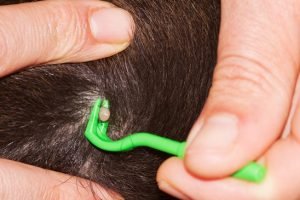
You'll need a tick removal tool — a small plastic hook device widely available from vets, pet shops, and online — or a pair of fine-tipped tweezers. A tick removal hook is preferable as it reduces the risk of squeezing the body. Do not use regular household tweezers with wide, flat ends.
- Stay calm and keep your dog still. Have someone help hold the dog if needed. Good lighting helps — a torch or moving to a well-lit area is worthwhile.
- Part the fur to expose the tick clearly. You want to see both the tick and where it's attached to the skin before you start.
- Position the tool as close to the skin as possible. With a tick hook, slide the prongs either side of the tick's body at the level of the skin. With tweezers, grip the tick as close to the skin surface as you can — not around the body of the tick.
- Pull steadily straight upward with even pressure. Do not jerk, twist, or squeeze. Apply gentle, continuous upward pressure until the tick releases. This may take a few seconds.
- Check that the mouthparts have come out with the tick. The tick should be intact. If any mouthparts remain in the skin, note it and contact your vet — don't try to dig them out yourself.
- Clean the bite site. Wipe with antiseptic or clean with soap and water. Wash your hands thoroughly.
- Dispose of the tick safely. Place it in a sealed bag or container and put it in the bin, or flush it. Do not crush it with your fingers.
- Note the date. Make a note of when and where the tick was found, and monitor your dog for signs of illness over the following weeks.
DO NOT
Things to Avoid When Removing a Tick
- Apply petroleum jelly, nail varnish, or any substance to the tick to "suffocate" it
- Use a lit match or any heat source to try to make it detach
- Apply alcohol, hand sanitiser, or essential oils to the tick
- Twist the tick as you pull — this can cause the mouthparts to break off
- Squeeze or crush the tick's body — this can force pathogens from the tick into the wound
- Remove it with your bare fingers without a tool
All of these methods can cause the tick to regurgitate its gut contents back into the bite wound, which increases the risk of transmitting any pathogens the tick may be carrying.
Diseases Ticks Can Carry in the UK
LYME DISEASE
The Most Important Tick-Borne Disease in UK Dogs
Lyme disease is caused by the bacterium Borrelia burgdorferi, which is carried by Ixodes ticks. Not all ticks in the UK carry it, and not all dogs bitten by an infected tick will develop disease — but the risk is real, particularly in high-risk areas such as the Scottish Highlands, the New Forest, Thetford Forest, Exmoor, and the South Downs.
Signs in dogs — and they may not appear until weeks or months after the bite:
- Shifting, intermittent lameness (moving between different legs)
- Lethargy and reduced energy
- Fever and reduced appetite
- Swollen or painful joints
- In severe cases, kidney involvement
Lyme disease in dogs is diagnosed by blood test and treated with antibiotics. Early treatment leads to better outcomes. If your dog has been bitten by a tick and develops any of these signs in the following weeks, mention the tick bite to your vet.
Other Tick-Borne Conditions in the UK
Anaplasmosis (Anaplasma phagocytophilum): A bacterial infection transmitted by Ixodes ticks that causes fever, lethargy, joint pain, and reduced appetite. Diagnosed by blood test; treated with antibiotics.
Babesiosis (Babesia canis): A parasitic infection affecting red blood cells. Historically rare in the UK but cases have been confirmed in Essex. Signs include lethargy, pale gums, reduced appetite, and dark urine. It requires specific veterinary treatment — standard treatments don't cover it. This is one reason tick prevention and prompt removal matter even when Lyme disease risk appears low in your area.
Preventing Ticks
Prevention is significantly easier than dealing with an attached tick or a tick-borne illness. A combination of product use and practical habits gives the best protection:
- Use a veterinary-recommended tick prevention product year-round — spot-ons, collars, and oral tablets all have different durations and spectrums of activity
- Check your dog from nose to tail after every walk in woodland, heathland, or long grass
- Keep to paths where possible in high-risk areas, particularly during peak tick season
- Check yourself after walks in tick-habitats too — ticks will attach to people as readily as dogs
- Keep the garden grass short if ticks are a concern in your area
Many tick prevention products require a veterinary prescription, particularly the more effective spot-ons and oral preparations. Ask your vet which product is most appropriate for your dog's size, health, and the areas you walk in.
When to Contact Your Vet
- You can't remove the tick completely — mouthparts are left in the skin
- The bite site becomes red, swollen, or infected in the days after removal
- Your dog develops lameness, lethargy, fever, or loss of appetite in the weeks following a tick bite
- You find multiple ticks at once — particularly on a puppy or small dog
- You want advice on tick prevention products appropriate for your dog
- Your dog has been in a known Lyme disease hotspot and you want guidance on monitoring
How Pet Med Direct Can Help
Pet Med Direct stocks tick prevention products for dogs in the UK. Some are available without a prescription; prescription-strength tick treatments require a valid veterinary prescription. Tick removal tools are also available without a prescription and are worth keeping to hand as a standard part of a dog owner's kit.
If your vet has recommended a specific tick prevention product, browse the Pet Med Direct shop to check availability. Always use products appropriate for your dog's size and follow the label instructions precisely — some spot-on products safe for dogs are toxic to cats.
Some tick prevention treatments require a valid veterinary prescription. Pet Med Direct can only supply prescription medicines after the prescription has been checked. Always follow your vet's advice and the directions on the medicine label.
Frequently Asked Questions
Do I need to see a vet every time my dog gets a tick?
Not necessarily if you can remove it cleanly and completely and your dog remains well. Monitor the bite site for signs of infection over the following few days, and watch your dog for signs of illness over the next few weeks. Contact your vet if the tick couldn't be fully removed, the site becomes infected, or your dog shows any signs of illness such as lameness, lethargy, or fever in the following weeks.
How long does a tick need to be attached to transmit Lyme disease?
The risk of Lyme disease transmission increases the longer a tick remains attached and feeding. While transmission can theoretically occur within hours in some cases, the risk is generally considered to be significantly lower in the first 24 to 48 hours. This is one reason regular tick checks after walks — and prompt removal — matter.
I removed the tick but some of the mouthparts stayed in. What should I do?
Don't try to dig them out — this risks pushing them deeper and causing more inflammation. Clean the area with antiseptic and monitor the site. In many cases the body will expel the remaining mouthparts naturally without intervention. If the area becomes red, swollen, or forms a lump, contact your vet, who can assess whether intervention is needed.
Can I catch Lyme disease from my dog?
You cannot catch Lyme disease directly from your dog — it's not spread from dog to person. However, a tick that has been on your dog might transfer to you during handling or while still questing in the environment. Always check yourself after walks in tick habitat, and wash hands after removing ticks from your dog. If you develop a bull's-eye rash (erythema migrans), fever, or joint pain after a tick bite, contact your GP.
Are some parts of the UK higher risk for ticks?
Yes. Ticks are present throughout the UK, but certain areas have higher tick populations and a higher proportion of ticks carrying Lyme disease. High-risk areas include the Scottish Highlands and islands, the New Forest in Hampshire, Thetford Forest in Norfolk and Suffolk, Exmoor, the South Downs, and the Lake District among others. That said, ticks can be found in parks, farmland, and gardens anywhere in the UK, so tick awareness and prevention is worthwhile wherever you are.
How do I know which tick prevention product is right for my dog?
This depends on your dog's weight, age, health status, and the type of areas you walk in. Some products cover ticks only; others combine tick, flea, and worm prevention. Prescription products are generally more effective for tick prevention than over-the-counter options. Your vet is the best person to advise on the most appropriate product for your dog's specific situation and your local tick risk.


Need pet products or prescription medicines? Visit the Pet Med Direct shop.
Shop Pet Med Direct