✓ Registered Vet Practice
🚚 Fast UK-Wide Delivery, Including Northern Ireland
℞ Prescription & Non-Prescription Products
→ Need to upload a prescription?

Heat Stress in Horses
The warning signs of heat stress in horses, why it is an emergency, how to start cooling while you phone your vet and how to prevent it.
Quick Answer
- If your horse shows signs of heat-related illness, stop exercise, phone your vet immediately and begin cooling straight away.
- UK sources say to move the horse into shade, offer water and keep pouring cold water continuously all over the body until help arrives.
- Do not use wet towels, sweat sheets or cooler rugs while cooling, because they act as an insulating layer.
- Staggering, anxious or odd behaviour, collapse, or a hot horse that has stopped sweating are signs of an emergency.
- Heat illness can progress to life-threatening heatstroke, sometimes without warning, so ask your vet early if you are worried.
Heat stress in horses happens when a horse cannot lose heat as fast as it makes it. Hot and humid weather can make a horse lethargic or cause sunburn and dehydration. At worst it can lead to heat exhaustion or heatstroke.
Heatstroke occurs when the internal body temperature becomes too high, and it can be fatal. This guide explains the signs, the first aid UK sources agree on and how to lower the risk.
What makes heat stress in horses more likely?
Horses cool themselves mainly by sweating. However, high humidity makes it harder for sweat to evaporate, and bright sun adds to the load. Wind helps cooling.
The RSPCA says research on horses working in the heat treats 28 to 30°C and above as hot, but humidity also matters.
A sudden change in temperature
Most healthy horses can get used to hot weather in time. Sudden big changes do not give them that chance.
What feels hot also depends on what the horse is used to. A horse that goes from around 15°C to 25°C may struggle more than one used to warm weather for weeks.
Exercise in the heat
If your horse has not been acclimatised, or the weather turns very hot, avoid prolonged or intense exercise. Avoid the hottest part of the day too.
Travelling
Horseboxes and trailers can get very hot inside, even when it is below 30°C outside. The more horses on board, the hotter and more humid it gets.
Horses that struggle more
Elderly horses, very young horses and those not in good health are more likely to struggle. So are overweight and unfit horses, while lean horses lose heat more effectively.
Horses with thick coats, for example because of PPID (Cushing's disease), need close monitoring. See Cushing's Disease (PPID) in Horses. Foals also cannot tolerate heat as well as adults.
Signs of heat stress in horses
Early signs of overheating can be easy to dismiss. Look out for:
- Heavy or excessive sweating, or no sweating despite the heat
- Fast or laboured breathing, or panting
- A hot feel to the touch
- A higher heart rate
- Lethargy, weakness or a drop in performance
- Reduced appetite, or dark urine
- A horse that is slow to recover after exercise
The BHS gives 37.5 to 38.5°C as the normal temperature range. A temperature that stays high, or only very slowly returns to normal after rest, can be a sign of heat exhaustion.
Some horses show "thumps". These are hiccup-like contractions, often with a thumping sound. Dark gums can also be a sign.
Emergency: Contact a Vet Immediately If…
- Your horse stumbles, staggers, wobbles or seems uncoordinated.
- Your horse is anxious, irrational, disorientated or behaving in an erratic or unpredictable way.
- A hot horse has stopped sweating and the skin stays hot to the touch.
- The temperature stays high after rest, or the horse cannot recover after exercise.
- You see "thumps", or the horse collapses or has convulsions.
Phone your vet or the nearest out-of-hours emergency vet straight away, and start cooling while you wait.
First aid for heat stress in horses
Stop exercise, phone your vet and start cooling at once. UK charities and the British Horseracing Authority (BHA) give very similar steps.
Do
- Move the horse into shade and offer water.
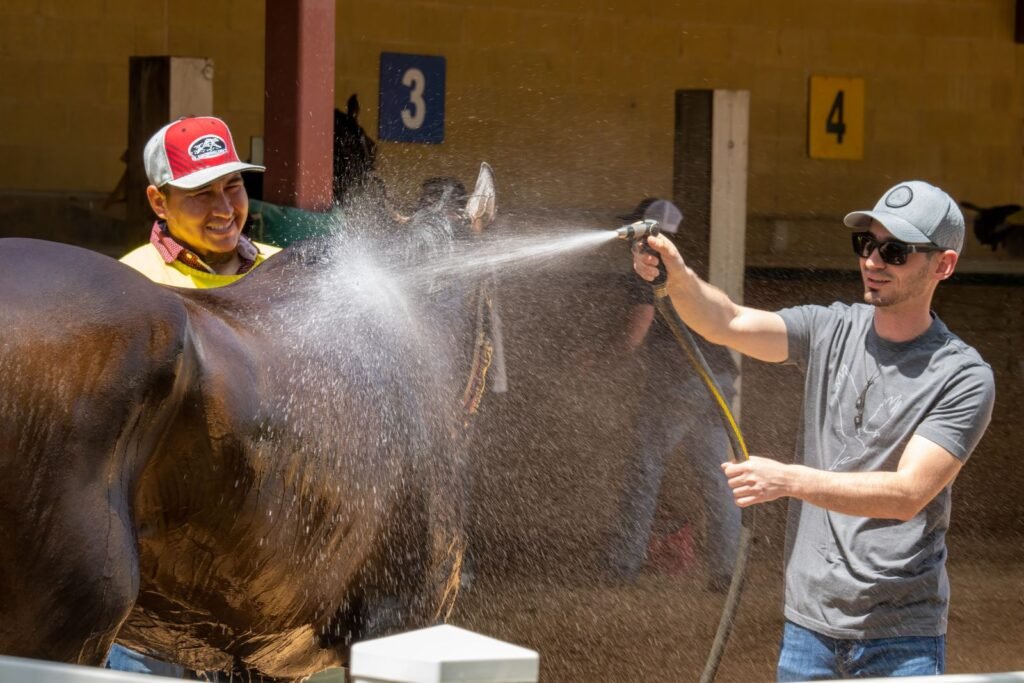
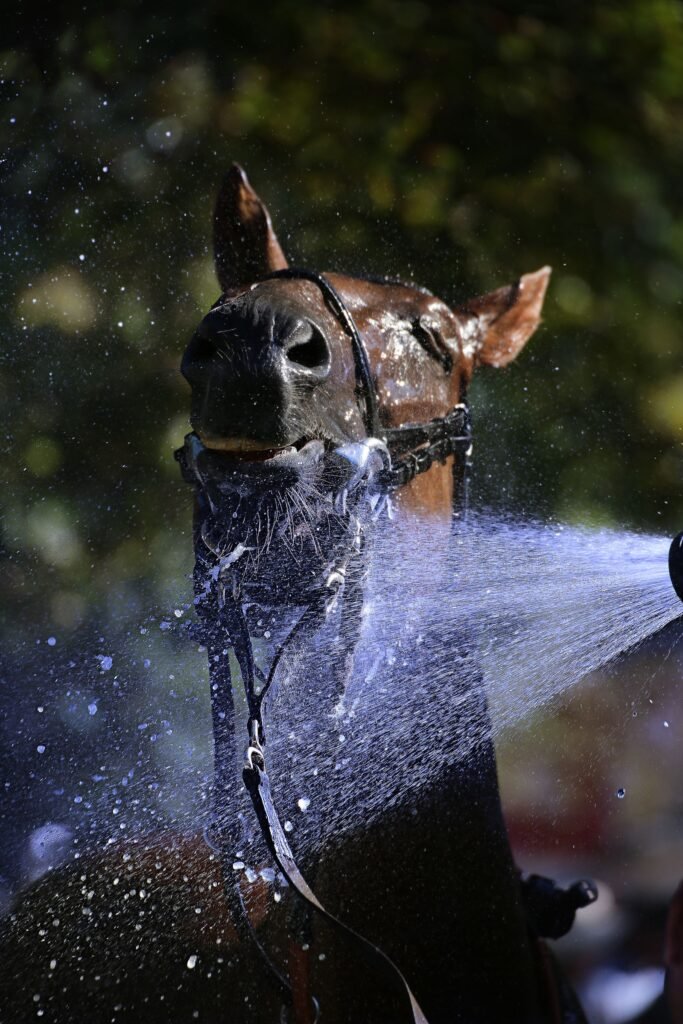
- Continuously apply cold water all over the body, as cold as is available, until help arrives.
- Pour in a controlled way over the neck and trunk. Smaller volumes lifted above the shoulders and hindquarters work better than heavy volumes thrown at the horse.
- Remove tack as soon as possible.
- Keep going. The BHS says it may take 10 to 15 minutes to see an improvement, and the RSPCA says around 15 minutes.
Some horses may not want water on their face. Sources differ on whether to walk the horse while cooling, so ask your vet on the phone.
Do not
- Do not apply wet towels, sweat sheets, wet rugs or cooler rugs. They act as an insulating layer.
- Avoid rugging the horse.
- Do not put the horse back in a stable or onto a lorry until it has cooled and dried, because it can heat up again.
- Do not scrape the water off between applications. The BHS and World Horse Welfare say it is not necessary, and the BHA says scrapers slow cooling.
The BHA racing policy says cold water does not cause shock, muscle damage or tying-up.
If the horse collapses
World Horse Welfare says to maintain the cooling from a safe position until your vet arrives. Heatstroke can make behaviour aggressive and dangerous, so your own safety comes first.
When to Contact Your Vet
- Any time your horse shows signs of heat-related illness after heat or exertion.
- If you have concerns about heat stress, even without the emergency signs above.
- If you suspect dehydration. One sign alone is not enough, but more signs mean a greater chance.
Heatstroke can lead to colic, laminitis, and kidney, liver or muscle damage, which is a further reason to involve your vet early. See Dehydration in Horses for the signs.
Preventing heat stress in horses
Defra expects keepers to take reasonable steps to protect animals from extreme weather and to make sure water is available. These habits help:
- Give constant access to clean, fresh water, with more than one source. Needs go up in hot weather: the BHS says 50 to 70 litres a day for a 500 kg horse, while the RSPCA says horses typically drink up to 55 litres a day and even more when it is hot.
- Provide shade at all times. Wooden stables can get extremely hot unless well ventilated, so a horse may be better out with shade.
- If you use a fan, place it where no horse can touch the fan or its power supply.
- Exercise in the cooler parts of the day, ride shorter or slower and allow extra cool-down time.
- Check the temperature of hose water first, because a hose lying in the sun can hold very hot water.
- Take care with fly rugs, which can make it harder to stay cool.
- Protect nose and other pink skin from sunburn, and test any sun cream on a small area first.
If you use electrolytes in water, always offer separate plain fresh water too.
Take care when travelling. The BHS and GOV.UK advise against transporting horses above 30°C without a temperature-controlled vehicle. Plan rest breaks every three to four hours, and offer water.
If you compete, check the current hot-weather rules of your governing body.
How Pet Med Direct Can Help
Heat stress is a situation for your vet first. Please phone your vet and begin cooling before you think about buying or giving anything.
You can browse our equine care and grooming range and our equine range. If your vet prescribes a medicine, prescription-only medicines (POM-V) are supplied solely against a valid prescription from the horse's own vet.
Some pet medicines require a valid veterinary prescription. Pet Med Direct can only supply prescription medicines after the prescription has been checked. Always follow your vet's advice and the directions on the medicine label.
Frequently Asked Questions
What is the difference between heat exhaustion and heatstroke?
Heat exhaustion can progress to life-threatening heatstroke, which can sometimes appear suddenly without warning. Either way, contact your vet immediately if your horse shows signs of heat-related illness.
Is it safe to put cold water on a hot horse?
UK sources say to cool with cold water all over the body. The BHA racing policy says it does not cause shock, muscle damage or tying-up. Phone your vet first and follow their advice.
Why should I avoid wet towels and cooler rugs?
Sweat sheets, wet rugs, towels and cooling blankets act as an insulating layer, which works against cooling. Pour cold water directly over the horse instead.
How hot is too hot for a horse?
There is no single answer. Research treats 28 to 30°C as hot, and Blue Cross says to be vigilant from 28°C when riding or competing. Humidity and what the horse is used to also matter.
Which horses are most at risk of heat stress?
Elderly, very young, overweight, unfit and thick-coated horses are more likely to struggle. Horses in poor health and foals are also at higher risk.
Should I keep my horse stabled in hot weather?
Not necessarily. Horses need shelter, but wooden stables can get extremely hot unless well ventilated. Stabling through the hottest hours only suits a stable that is cool and well ventilated.
Related Equine Health Guides
Sources and Further Reading
- The British Horse Society — Horse care in hot weather
- The British Horse Society — Exercise, competing and travelling a horse in the heat
- The British Horse Society — Hot weather safety advice
- World Horse Welfare — Heatstroke in horses
- World Horse Welfare — Hot weather horse care tips
- World Horse Welfare — Heatwaves and horses: what every owner needs to know
- RSPCA — Keeping Your Horse Cool in Summer
- GOV.UK (Defra) — Keeping farm animals and horses in extreme weather
- British Horseracing Authority — Hot Weather Policy
- Blue Cross — Keeping horses safe in the summer sun
This article was researched from the sources listed above. It is general information for horse owners and is not a substitute for advice from your own vet.

Need pet products or prescription medicines? Visit the Pet Med Direct shop.
Shop Pet Med Direct