£90.00–£146.00Price range: £90.00 through £146.00 Inc VAT
Prescription Required
NI - Only Postage
Cytopoint injection for dogs
PRESCRIPTION NEEDED (Pom-V)
Important Delivery Notice
Please note that this is an injectable medication and must be delivered directly to your veterinary practice for administration. We are unable to send this product to a residential address.
By ordering this item, you agree to provide your vet practice details for delivery.
If vet practice details are not supplied, the order will be cancelled and a £5 administration fee will be deducted from the refund.
Cytopoint is a prescription-only injectable treatment for dogs with allergic or atopic dermatitis. It contains lokivetmab, a caninised monoclonal antibody that specifically targets and neutralises interleukin-31 (IL-31), a key itch signal in dogs. By blocking IL-31, Cytopoint helps to rapidly reduce itching and improve skin comfort, often within a few days.
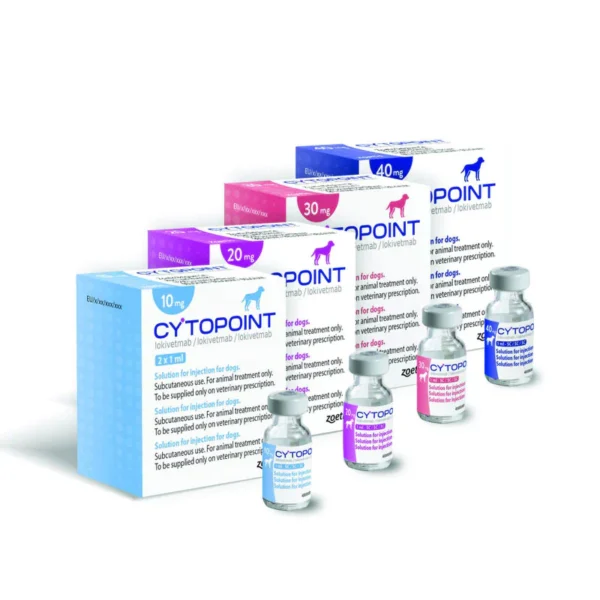
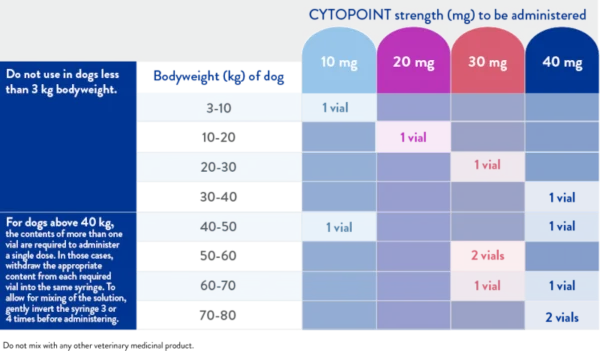
Cytopoint comes in four vial strengths – 10 mg, 20 mg, 30 mg and 40 mg – so your vet can choose the correct dose based on your dog’s bodyweight. It is given as a subcutaneous injection by your vet, usually once every 4–8 weeks, depending on your dog’s response and the vet’s recommendation. Cytopoint is a POM-V medicine and can only be supplied against a valid veterinary prescription, with injections administered under veterinary direction.
Key points:
Prescription-only (POM-V) injectable for dogs with allergic or atopic dermatitis
Active ingredient: lokivetmab (monoclonal antibody against IL-31)
Helps control itch and skin signs associated with atopic dermatitis
Four strengths: 10 mg, 20 mg, 30 mg and 40 mg vials
Given as a subcutaneous injection, usually every 4–8 weeks as advised by your vet
Available in 10mg, 20mg, 30mg & 40mg – 2 x 1ml Vial
Ordering This Prescription Medicine
A valid veterinary prescription is required before dispatch.
Add the medicine, strength and quantity shown on your prescription to your basket.
Upload your prescription at checkout, or send it to us afterwards by email.
Complete checkout — we’ll verify your prescription before dispatch.
All orders require review by a licensed veterinarian.Please allow 1–2 working days for processing.
Please note that this is an injectable medication and must be delivered directly to your veterinary practice for administration. We are unable to send this product to a residential address.
By ordering this item, you agree to provide your vet practice details for delivery.
If vet practice details are not supplied, the order will be cancelled and a £5 administration fee will be deducted from the refund.
Cytopoint injection for dogs – targeted itch relief for allergic and atopic dermatitis
Cytopoint is a modern, targeted treatment that helps control the persistent itching seen in dogs with allergic and atopic dermatitis. Unlike traditional medicines such as steroids or some tablets that act broadly on the immune system, Cytopoint is a caninised monoclonal antibody designed to focus on one key itch signal: interleukin-31 (IL-31). By binding to IL-31 and blocking its action, Cytopoint reduces the feeling of itch so your dog can scratch less, sleep better and allow their skin time to heal.
What Cytopoint is used for
Vets use Cytopoint in dogs for:
The treatment of pruritus (itching) associated with allergic dermatitis
The treatment of clinical manifestations of atopic dermatitis such as redness, scratching, licking and skin lesions
Allergic and atopic dermatitis are long-term conditions in many dogs and can be triggered by environmental allergens (pollens, house dust mites), fleas, food or a combination of factors. Cytopoint helps to control the itch and skin discomfort while your vet works with you on flea control, diet changes, skin care and environmental management.
Available strengths and dosing
Cytopoint is supplied as single-use vials containing a sterile solution for injection in four strengths:
Cytopoint 10 mg – 2 vials of 1ml
Cytopoint 20 mg – 2 vials of 1ml
Cytopoint 30 mg – 2 vials of 1ml
Cytopoint 40 mg – 2 vials of 1ml
Your vet calculates the dose based on your dog’s bodyweight (using a recommended mg/kg dosage range) and will select the appropriate vial or combination of vials to reach that dose. The injection is given under the skin (subcutaneously), usually at the vet practice.
In many dogs ,the effect of one injection lasts for around 4 weeks, but the interval can range from about 4–8 weeks, depending on the individual dog and the severity of their allergy. Your vet will advise when repeat injections are needed based on your dog’s signs.
How Cytopoint works
Cytopoint contains lokivetmab, a caninised monoclonal antibody (mAb). Monoclonal antibodies are proteins that recognise and bind to specific targets in the body. In this case, lokivetmab binds to canine IL-31, a signalling protein strongly involved in the sensation of itch.
When IL-31 is blocked by lokivetmab:
The itch signals sent to the brain are reduced
Dogs scratch, lick and chew less
Skin has a better chance to recover from self-trauma
Because Cytopoint is designed specifically for dogs and targets IL-31 rather than broadly affecting the immune system, it is often considered a focused option for itch control and may be suitable for dogs where long-term steroids or certain other immunomodulatory drugs are not ideal.
How Cytopoint is given
Cytopoint is an injectable medicine and is usually given by your vet or a trained veterinary nurse. It is not a tablet or liquid to give at home. The injection is given just under the skin, typically at the back of the neck or between the shoulder blades. Most dogs tolerate the injection very well and there is no need for sedation.
Important points:
Cytopoint is prescription-only (POM-V)
Your dog must be examined by a vet before it is prescribed
Only trained professionals should administer the injection
The dosing interval (e.g. every 4 weeks) is set by your vet according to your dog’s response
You should not attempt to split or re-use vials; they are single-use only
Benefits of Cytopoint
When used as part of a full allergy management plan, Cytopoint can provide several benefits:
Rapid itch relief in many dogs, often within a few days of injection
Improved comfort, less scratching and better sleep for both dog and owner
Reduced self-trauma to the skin, which can help other treatments such as shampoos or topical therapies work more effectively
Targeted mode of action that focuses on IL-31 rather than broadly suppressing the entire immune system
Convenient dosing schedule (typically once every 4–8 weeks)
Monitoring and long-term management
Allergic and atopic dermatitis tend to be long-term or lifelong conditions. Cytopoint is often used as part of ongoing management, which may also include:
Strict flea control
Diet trials or long-term dietary management
Medicated shampoos, ear treatments or topical products
Environmental changes to reduce triggers where possible
Your vet will review your dog regularly, assess skin condition and itch levels, and decide how often Cytopoint injections are needed. Over time, the dose interval may be adjusted based on your dog’s control and seasonal patterns.
Safety, contraindications and precautions
Cytopoint is only for use in dogs. It must not be used in other species. Your vet will discuss your dog’s medical history and any concurrent medications before deciding if Cytopoint is appropriate.
Cytopoint is generally well tolerated in most dogs. Most commonly reported side effects are mild and may include transient digestive upset or lethargy. Serious reactions are uncommon, but as with any injectable product, there is a small risk of allergic or hypersensitivity reactions. Contact your vet immediately if you notice:
Sudden swelling of the face, muzzle or eyelids
Difficulty breathing or collapse
Marked lethargy, vomiting, diarrhoea or other worrying signs after the injection
Because Cytopoint is targeted at IL-31 and is broken down similarly to natural antibodies in the body over time, it may be an option for dogs where other systemic treatments are not ideal, but your vet is best placed to advise for your particular dog.
Handling advice for owners
Cytopoint vials are stored and handled by veterinary professionals, so you will not usually need to handle the product yourself. If you are given any documentation or packaging, keep it safely away from children and other animals and follow your practice’s advice for any returns or disposal.
Frequently asked questions about Cytopoint injection for dogs
Is Cytopoint a prescription-only medicine? Yes. Cytopoint is classified as a POM-V product, which means a veterinary surgeon must prescribe it.
How quickly does Cytopoint work? Many dogs show a reduction in itch within a few days after the injection, but the speed and extent of response can vary between individuals. Your vet will discuss what to expect and when to review progress.
How long does one Cytopoint injection last? The effect typically lasts for around 4 weeks in many dogs, but some may need injections slightly more or less often (for example every 4–8 weeks). Your vet will recommend a suitable schedule based on your dog’s signs and response.
Can Cytopoint cure atopic dermatitis? Cytopoint does not cure the underlying allergic tendency, but it helps control the itching and associated skin signs. Most dogs with atopic dermatitis need ongoing management that includes lifestyle changes, parasite control and sometimes diet, alongside treatments like Cytopoint.
Can Cytopoint be used with other medicines? Cytopoint is often used alongside other treatments such as flea products, antibiotics, ear drops, shampoos or some other allergy medications. However, only your vet can decide which combinations are safe and appropriate for your dog. You should always tell your vet about any other medicines or supplements your dog is receiving.
What if my dog’s itching returns before the next due injection? Contact your vet if the itch returns early or seems poorly controlled. They may wish to examine your dog, check for secondary infections or parasite issues, and review the injection interval or overall treatment plan.
Always follow the advice on the prescription, the package leaflet and your veterinary clinic’s instructions when your dog is treated with Cytopoint. If you have any concerns about side effects, itch control or the timing of injections, speak to your vet for guidance.
This product must be prescribed by a VET, and you must follow their guide for dosage and administration.
Available in 10mg, 20mg, 30mg & 40mg – 2 x 1ml Vial


 Prescription Required
 Prescription Required
 Prescription Required
 Prescription Required