✓ Registered Vet Practice
🚚 Fast UK-Wide Delivery, Including Northern Ireland
℞ Prescription & Non-Prescription Products
→ Need to upload a prescription?

How Do I Know If My Cat Has Asthma?
A plain guide to cat asthma: the signs, what an attack looks like, how vets diagnose it and how it is managed.
Quick Answer
- Cat asthma is a long-term disease of the small airways in the lungs, in which the airways become inflamed and narrowed, making breathing difficult.
- Typical signs are persistent coughing, often in short bouts, fast or open-mouthed breathing, noisy breathing and wheezing, and these can come and go and go unnoticed for some time.
- Struggling to breathe, open-mouth breathing, panting, a rapidly moving chest, or weakness and collapse may mean an asthma attack, which is an emergency, so call your vet immediately.
- There is no single test for asthma, so your vet examines your cat and rules out other conditions with similar signs, such as heart disease, lungworm and infections.
- Asthma cannot be cured, but most cats lead happy, active lives with treatment, which is usually lifelong.
Cat asthma works rather like asthma in people: the airways become inflamed and narrow, which makes breathing harder. In a cat it often starts as a mild cough, so it is easy to miss or to mistake for a hairball.
This guide covers the condition itself: the signs, attacks, diagnosis and long-term care. For the wider list of reasons a cat might cough, see Why Is My Cat Coughing?
What Is Cat Asthma and What Causes It?
What happens in the airways
In asthma, the smooth muscle in the airways contracts, mucus production increases, and the airways become inflamed and narrowed. You may also see it called feline chronic small airway disease, feline bronchitis, allergic airway disease or allergic bronchitis. Chronic bronchitis is a related condition with extra thick, sticky mucus, and the two are currently treated in similar ways.
Possible causes and triggers
Asthma is usually caused by an allergy to something in the cat's home, such as pollen or dust. The exact cause is not completely understood. In some cats it is an allergic response to an irritant, and in others no allergic cause is found.
Possible triggers include pollen, grass, mould, dust mites, tobacco smoke, cat litter, household cleaning products, household sprays and some foods. In some cats the disease is seasonal or only happens in certain rooms. However, in most cats specific triggers cannot be found or avoided.
Which cats are affected
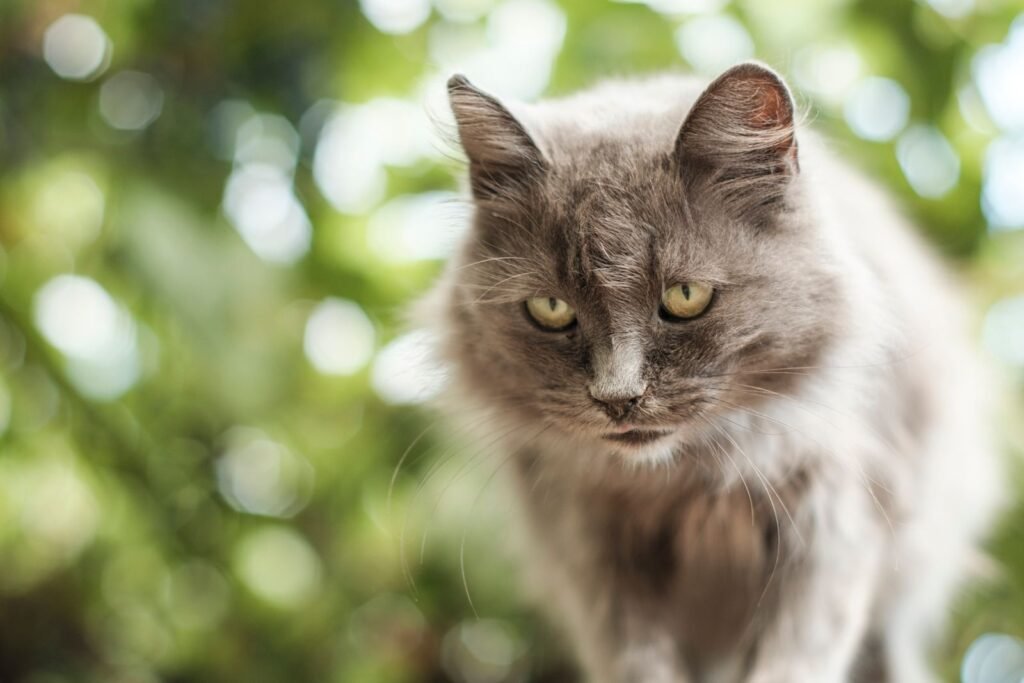
Chronic airway disease can affect cats of any age, breed or sex. It is often seen in Siamese and related breeds, so there may be an inherited component. Being overweight can worsen breathing difficulties and the severity of asthma. If you are worried about your cat's weight, see Is My Cat Overweight?
Signs of Cat Asthma to Look For
Asthma often starts with a mild cough. Over time the airways can become more inflamed, narrow and sensitive. The signs can be constant or come and go, so they may not be noticed for some time.
- Persistent coughing, often in short bouts. It can come and go and sometimes causes vomiting.
- Fast breathing, open-mouthed breathing or panting, which can happen after exercise such as play.
- Noisy breathing and wheezing.
- Difficulty breathing, or increased effort to breathe.
- Frothy mucus while coughing, gagging, or extending the neck upwards and gasping.
- Weakness and lethargy.
A cat with asthma can cough in a way that looks like it is trying to be sick, retching or gagging with its neck stretched out and body crouched low. This is easily mistaken for hairballs. Snoring or loud breathing while resting is not necessarily a sign of asthma.
Most cats breathe so quietly that you should not hear or see it unless you look and listen closely. If you can, film any coughing or abnormal breathing on your phone to show your vet.
What an Asthma Attack Looks Like in Cats
Asthma attacks are serious and potentially life-threatening episodes in which the airways become severely narrow and can even close completely.
In a minor attack, a cat may cough and struggle to stop, hunched with its neck out straight and head close to the ground. It may breathe faster and wheeze. In a severe attack, breathing is difficult and the sides visibly heave in and out. In extreme cases a cat may pant, look frightened, cough up mucus or drool.
Any suspected attack is an emergency and the cat must be seen by a vet urgently. Left untreated, in severe cases, asthma can cause life-threatening attacks.
Emergency: Contact a Vet Immediately If…
- Your cat is struggling to breathe, or its chest is moving rapidly.
- Your cat is breathing with its mouth open or panting. Cats nearly always breathe through their nose, so this means they are extremely stressed or really struggling to breathe. Panting in cats is never normal.
- Your cat's sides are visibly heaving in and out.
- Your cat has pale, white, grey, blue or bright red gums.
- Your cat is weak or has collapsed, or is getting rapidly worse.
Call your vet or the nearest emergency vet straight away and, if possible, have someone phone ahead to say you are coming and why. Never wait to see if things improve.
What to Do During an Attack
- Stay calm and keep your cat calm, because stress makes breathing worse.
- Give any medication your vet has prescribed.
- Move your cat to a cool, quiet area with good ventilation, and avoid wrapping it in blankets.
- Contact your vet straight away. Any suspected attack is an emergency, so do not delay.
- On the way, keep the car well ventilated with a window open, and keep your cat as calm as you can.
When to Contact Your Vet
- Your cat has coughing, wheezing or noisy breathing that comes and goes. Book an appointment and do not wait.
- Your cat has any signs of asthma, even mild ones, as ongoing untreated asthma may permanently damage and scar the airways.
- Your cat has a persistent cough or is retching in a way that could be mistaken for a hairball.
- Your cat already has asthma and its breathing changes.
Even mild signs that come and go need a vet visit. Treatment should start as soon as possible.
How Vets Diagnose Asthma in Cats
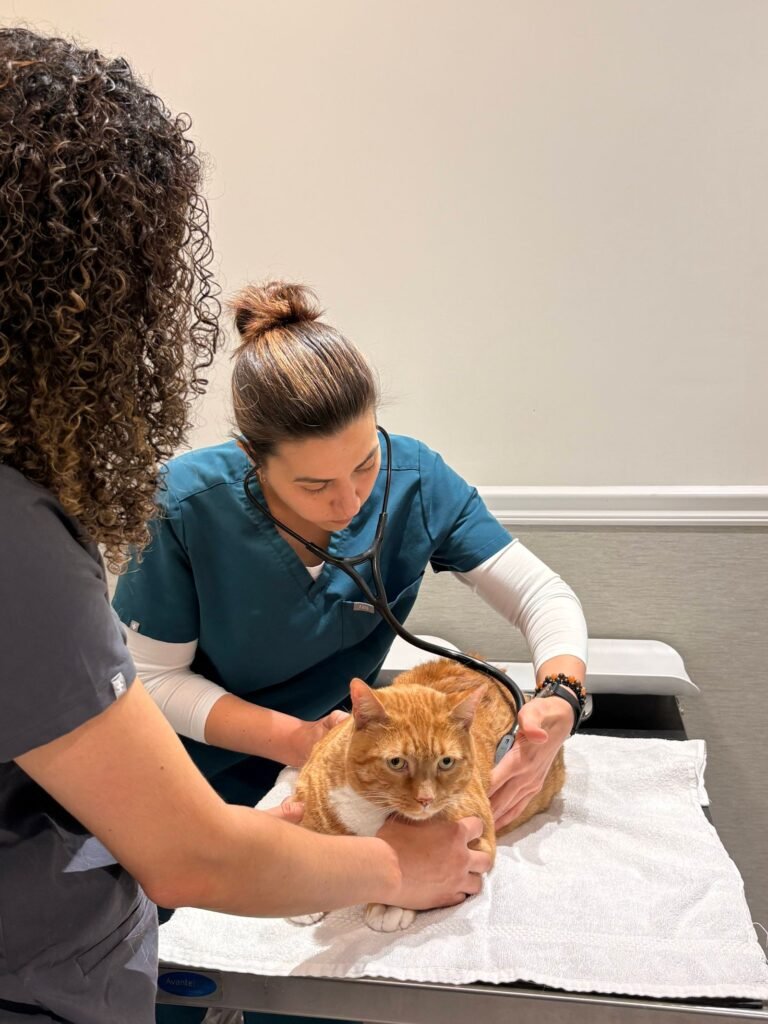
Your vet will take a detailed history, examine your cat and listen to its chest with a stethoscope. There is no single test that accurately diagnoses asthma. Because other conditions cause similar signs, the vet needs to rule out problems such as heart disease, lungworm and infections.
Tests may include blood tests, faeces testing for lungworm, X-rays or CT, a heart scan, bronchoscopy and airway washes. Your cat will be anaesthetised for most of these. If investigation is not possible and asthma is highly likely, your vet may suggest a trial of asthma medication and monitor the response.
Long-Term Management of Cat Asthma
Most cats with asthma need treatment to control coughing and wheezing and to prevent permanent harmful changes in the lungs. There are two main types of treatment: anti-inflammatory medicines to reduce airway inflammation, and bronchodilators to widen the airways. Anti-inflammatory treatment is usually given every day, and your vet will explain how and when to give each medicine.
They are ideally given by inhaler, using a special spacer with a face mask designed for cats, so the medicine reaches the lungs where it is needed and the chance of unwanted side effects is reduced. Medicine can also be given as tablets, liquid or injections. Most cats tolerate the inhaler very well, and with practice it is easier than giving tablets.
Introduce the mask slowly over a couple of weeks. Reward your cat with treats, and stop immediately if it shows signs of stress. Always follow your vet's instructions.
Do not use your own inhaler on your cat. It is not advised and may cause problems. Steam or salt inhalation may seem soothing, but there is no scientific evidence it works for asthma and it may irritate, so check with your vet first.
Reducing Triggers at Home
- Keep the air as pure as possible: avoid sprays, incense sticks, plug-in diffusers, perfumes, air fresheners and aerosols.
- Keep a smoke-free household and vacuum regularly.
- Use a dust-free, unscented litter.
- Consider an air filter or purifier, particularly for cats that stay mostly indoors.
- Keep your cat at a healthy weight.
- If pollen is a trigger, you could limit outside access when pollen levels are highest.
- Keep a diary of attacks (time, date, severity and treatment given) to spot seasonal or environmental patterns.
Outlook and Costs
Asthma cannot be cured, but most cats lead relatively normal, happy lives with daily medication. Most need life-long therapy, so do not stop treatment. Instead, talk to your vet about whether the medication can be reduced. In severe cases, or those that do not respond to treatment, asthma can shorten life expectancy.
Treatment can be expensive because it is lifelong and needs regular check-ups. There is often more than one option, so talk openly to your vet about finances. Many insurers do not cover pre-existing conditions such as asthma, so it is worth insuring early, before any signs of illness.
How Pet Med Direct Can Help
Pet Med Direct is an online pet pharmacy. Because cat asthma is a long-term condition, your cat may need ongoing medicine. You can read how pet prescriptions work and how repeat pet prescriptions are handled.
Our respiratory category contains prescription-only medicines, supplied solely against a valid prescription from your cat's own vet. This is not a suggestion that your cat needs them. See also our cat medication range.
Some pet medicines require a valid veterinary prescription. Pet Med Direct can only supply prescription medicines after the prescription has been checked. Always follow your vet's advice and the directions on the medicine label.
Frequently Asked Questions
Can cats get asthma?
Yes. Just like people, cats can get asthma. In cats it is a long-term disease of the small airways, with inflamed, narrowed airways that make breathing difficult.
Is cat asthma curable?
No, but it can be managed. With the right care and medication, most cats live relatively normal and happy lives. Most need treatment for life.
Can I use my own inhaler on my cat?
No. Giving your cat your inhaler is not advised and may cause problems. Your vet will recommend an inhaler suitable for cats, used with a spacer and mask.
Is my cat's cough asthma or a hairball?
It can be hard to tell, because an asthma cough can look like retching. Film the episode and show your vet. Your vet decides the cause after examining your cat and ruling out other conditions.
Can asthma be life-threatening?
Yes. Asthma attacks can be life-threatening, and sudden attacks can prove fatal if the condition is untreated. That is why any suspected attack is an emergency and early treatment matters.
Related Cat Health Guides
Sources and Further Reading
- International Cat Care — Asthma and chronic bronchitis in cats
- Cats Protection — Feline Asthma
- Cats Protection — Feline asthma, Veterinary Guide 13
- Blue Cross — Asthma in cats
- PDSA — Cat Asthma
- PDSA — Breathing problems in cats
- PDSA — First aid for pets struggling to breathe
- Vets Now — How to: first aid for breathing problems in pets
- Royal Veterinary College — Respiratory distress in cats and dogs
- Blue Cross — Emergencies in Cats
This article was researched from the sources listed above. It is general information for cat owners and is not a substitute for advice from your own vet.

Need pet products or prescription medicines? Visit the Pet Med Direct shop.
Shop Pet Med Direct