✓ Registered Vet Practice
🚚 Fast UK-Wide Delivery, Including Northern Ireland
℞ Prescription & Non-Prescription Products
→ Need to upload a prescription?

Why Is My Cat Licking Itself So Much?
Grooming is normal, but a cat licking itself until the fur thins or the skin looks sore may have itchy skin, pain or stress.
Quick Answer
- Grooming throughout the day is a normal part of a cat's routine, but grooming to the point of hair loss or sore skin could indicate an underlying problem.
- Causes of over-grooming fall into three groups: skin problems such as fleas and allergies, underlying pain, and stress.
- Vets rule out medical causes first, so call your vet before assuming that stress or boredom is behind it.
- Straining to pee, or repeated trips to the litter tray passing little or nothing, is an emergency, and licking the belly or back end can go with it.
- A short video of the behaviour can help your vet see what your cat is doing.
It is normal to see a cat licking itself throughout the day. Over-grooming is any grooming that goes beyond normal coat care and scent spreading.
The worry starts when the licking leads to hair loss or sore skin. PDSA also says grooming too much, or too little, could be a real cause for concern.
This guide is about the behaviour and what lies behind it. For the wider list of reasons for bare patches, see our guide to why a cat is losing fur.

Why Is a Cat Licking Itself So Much?
Over-grooming is often caused by a skin problem, underlying pain or stress. Most cases begin with a skin or pain problem, and there is reason to believe that most also have a stress element.
Signs of over-grooming include patches of broken or sparse hair, complete hair loss in some areas and sometimes damaged skin. Your cat may bite or chew at the skin and be hard to distract.
Itchy skin: fleas, allergies and more
Anything that makes the skin itchy can make a cat groom more. Hypersensitivity to flea saliva, known as flea allergic dermatitis, is one of the most common causes of over-grooming. You may not see any fleas, because a cat that over-grooms removes them.
Cats can also react to something in their diet or to substances in the environment. Other possible causes include insect bites, mites, lice and food allergies. Early signs of parasites can be a cat grooming more than usual or small areas where the fur looks thinner.
Excessive grooming or scratching of affected areas is a sign of possible skin problems, so have your vet check your cat. See how to know if your cat has fleas and why cats scratch so much.
Pain, including arthritis
A cat with a sore patch of skin or a painful body part may groom that area more than usual to soothe the pain. In arthritis, cats may over-groom painful joints, leaving stained fur and hair loss.
Pain can also work the other way round. Obesity, arthritis or dental disease can make it hard for a cat to groom properly, which leads to a poor coat, matting and dandruff.
Bladder pain and belly licking
Lower urinary tract disease can cause bladder pain, and some cats over-groom the painful area. A common sign is a bald or sparse patch on the lower belly, inner thighs and around the genitals.
Feline idiopathic cystitis is a painful condition thought to be partly caused by stress. Signs can include straining or painful urination, frequent small amounts of urine, blood in the urine and peeing outside the tray. If it becomes severe, it can block the urinary tract, which is an emergency that can be life threatening. Male cats are more at risk of blocking.
Please read our guide on why a cat strains to urinate if your cat is licking the belly or back end.
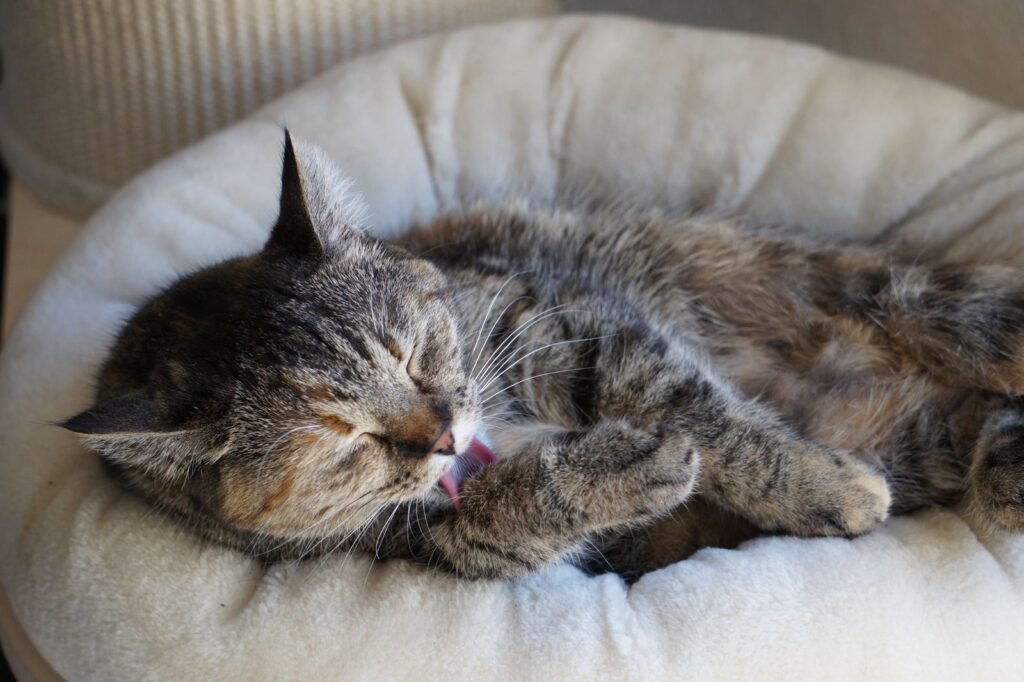
Stress, boredom and anxiety
Cats often use grooming to make themselves feel better in stressful situations. It can become compulsive if it happens out of context, and so often disrupts normal activity.
Once medical causes have been ruled out, stress is one big reason many cats over-groom. Triggers include moving home, building work, a new baby or another pet. Cats like routine, so disruption can show up as over-grooming.
Living with another cat can be stressful if they feel they must compete for food, resting spots or attention. Confined indoor cats with little to do can also become stressed. Other signs of chronic stress include hiding, resting more, changes in eating or toileting, and spraying indoors.
For a small number of cats, the problem is entirely due to stress, but a vet should still check first.
Less common causes
Feline hyperaesthesia syndrome is poorly understood. It leads to behaviours such as skin twitching and sudden bouts of intense grooming. Other medical conditions, including an overactive thyroid, diabetes, liver disease, and FIV or FeLV infection, can also lead to skin problems.
Signs to Look For
A cat licking itself is hard to judge, because many cats are secret groomers. They may only lick, bite and scratch when alone. These clues can help:
- Patches of broken, sparse or missing hair, often on the belly, the insides of the back legs and the flanks.
- Patches that look similar on both sides of the body.
- Spiky, sharp hair stubble in the area, which suggests hair is being removed by grooming.
- Red, sore or damaged skin, scabs or very clearly edged bald patches.
- A cat that is hard to distract from licking or chewing.
- Hairball vomiting or constipation, which can follow swallowing hair.
- Other changes, such as rash, scaly skin, drinking more, being less energetic or eating more or less.
A cat's rough tongue can break hairs and damage skin when grooming excessively.
Emergency: Contact a Vet Immediately If…
- Your cat is straining to pee, or making repeated trips to the litter tray with little or nothing passed. Licking around the belly or back end can go with this.
- Your cat is crying out when trying to pee, or has blood in the urine.
- Along with licking around the back end or belly, your cat is hiding, has low energy or weakness, is eating less, is vomiting, or has a painful, tense tummy.
Never wait to see if your cat improves, because a blocked bladder can cause death if left untreated. Male cats are much more likely to block. Call your vet immediately, or the nearest out-of-hours emergency vet.
When to Contact Your Vet
- Your cat is over-grooming, or licking or scratching more than normal. Contact your vet as soon as possible.
- There is hair loss, sore or broken skin, or scabs.
- The licking carries on for more than a few days.
- You notice any change in behaviour or other signs of ill health.
Always call your vet first, because there are several medical reasons for over-grooming. Over-grooming on its own is not described as an emergency, but it should not be left.
How Your Vet Works Out the Cause
If your cat is licking itself this much, your vet will look for an underlying medical problem first. They will take a detailed history and examine your cat. They may also check hair or skin samples, and run blood tests, urine tests, X-rays or ultrasound scans. Looking at hairs under a microscope can show whether a cat is damaging them.
Flea allergy is usually ruled out first with regular flea treatment, then other skin causes such as allergy. Without a video, your vet may not see the behaviour, so film your cat if you can.
Treatment depends on the cause. If stress is suspected, your vet will advise on reducing it and may refer you to a qualified clinical animal behaviourist. A buster collar or body suit may be used briefly at the start of a flea-allergy flare-up, only until medication works. It stops scratching but not the itch, and is never a long-term solution.
Reducing Stress at Home
If stress is behind your cat licking itself, and your vet has ruled out medical causes, these steps can help:
- Keep to a daily routine, and let your cat choose when to interact.
- Provide one of every resource per cat, plus an extra one, in different places: food bowls, water, litter trays, toys and beds.
- Offer hiding places, including high ones, and somewhere safe during a house move or building work.
- Give daily play and puzzle feeders, and things to climb.
- Use a microchip cat flap if neighbouring cats come into the house.
- Ask your vet about synthetic feline pheromones if you think they could help.
What Not to Do
Please do not assume it is just stress without a vet check. Do not treat the problem yourself without a diagnosis either, as home remedies may not work and could make things worse.
Be wary of non-prescription flea products that claim to treat flea allergy, as many lack evidence. Cats with feline idiopathic cystitis do not have a bacterial infection and should not be given antibiotics, so only give medicines your vet has prescribed for this cat. Do not change your cat's diet during an episode of cystitis or other illness.
How Pet Med Direct Can Help
Pet Med Direct stocks ranges of non-prescription cat calming and stress products and cat skin care products. Stress is only one possible cause, so please speak to your vet first.
If your vet prescribes a medicine, you can see how pet prescriptions work.
Some pet medicines require a valid veterinary prescription. Pet Med Direct can only supply prescription medicines after the prescription has been checked. Always follow your vet's advice and the directions on the medicine label.
Frequently Asked Questions
Is a cat licking itself a lot normal?
Yes. Grooming throughout the day is normal. The warning signs are bald patches, sore skin and a cat that cannot be distracted from licking.
Can stress alone cause bald patches?
Sometimes. In a small number of cats the problem is entirely due to stress. Even so, vets rule out medical causes first.
Why is my cat licking its belly?
It could be allergy, fleas, pain or cystitis. If your cat is also straining to pee or crying out in the litter tray, treat it as an emergency and contact your vet immediately.
Why have I never seen my cat doing it?
Many cats are secret groomers and only lick, bite and scratch when alone. The first thing you notice may be a bald patch.
Should my cat wear a cone or body suit?
Only if your vet advises it. A buster collar or body suit may be used briefly at the start of a flea-allergy flare-up, until medication works. It is not a long-term solution.
Can over-grooming cause hairballs?
It can. Over-grooming can lead to vomiting of hairballs or constipation from swallowed hair. Our guide to cats losing fur explains what to do about bare patches.
Will my cat get better?
It depends on the cause, so your vet is the best person to ask. For example, a cat with flea allergy that is treated is likely to live a normal, happy life, although flea control must continue.
Related Cat Health Guides
Sources and Further Reading
- International Cat Care — Over-grooming in cats
- PDSA — Vet Q&A: Is my cat grooming too much?
- PDSA — Hair loss (alopecia) in cats
- International Cat Care — Itchy cat: when it is not fleas
- International Cat Care — Feline idiopathic cystitis (FIC) in cats
- PDSA — Feline Idiopathic Cystitis (FIC)
- PDSA — Blocked Bladder in cats
- International Cat Care — Stress in cats
- PDSA — Preventing stress in cats
- PDSA — Flea Allergic Dermatitis in cats
- PDSA — Arthritis in cats
- PDSA — Dermatitis (red, inflamed, sore skin or a rash) in cats
- Cats Protection — Skin disorders leaflet
- Cats Protection — Why does my cat overgroom? and other behaviour FAQs
- Cats Protection — Skin Problems in Cats
- Cats Protection — Why is my cat so itchy?
- Blue Cross — Skincare for cats
This article was researched from the sources listed above. It is general information for cat owners and is not a substitute for advice from your own vet.

Need pet products or prescription medicines? Visit the Pet Med Direct shop.
Shop Pet Med Direct