✓ Registered Vet Practice
🚚 Fast UK-Wide Delivery, Including Northern Ireland
℞ Prescription & Non-Prescription Products
→ Need to upload a prescription?

Lice in Horses
How to spot lice, why they are more of a problem in the colder months, and what to ask your vet about treatment.
Quick Answer
- Lice in horses are tiny wingless insects that live on the horse and cause itching, rubbing and a dull, scruffy or patchy coat.
- They tend to be more of a problem in the colder months, when thick winter coats and warm rugs give them a warm place to multiply.
- You can often see lice or their white eggs (nits) by parting the hair and looking closely in good light.
- Your vet advises the treatment, which is usually repeated because products kill adult lice rather than eggs, and in-contact horses are treated too.
- Itching has other causes, so ask your vet to check if you are not sure.
Lice in horses are a common cause of itching in the colder months. They are small, flattened, wingless insects, usually 2–4 mm long, and they can often be seen with the naked eye.
Treatment is usually straightforward, but a few points catch owners out. This guide covers what to look for, how lice spread and what to ask your vet.
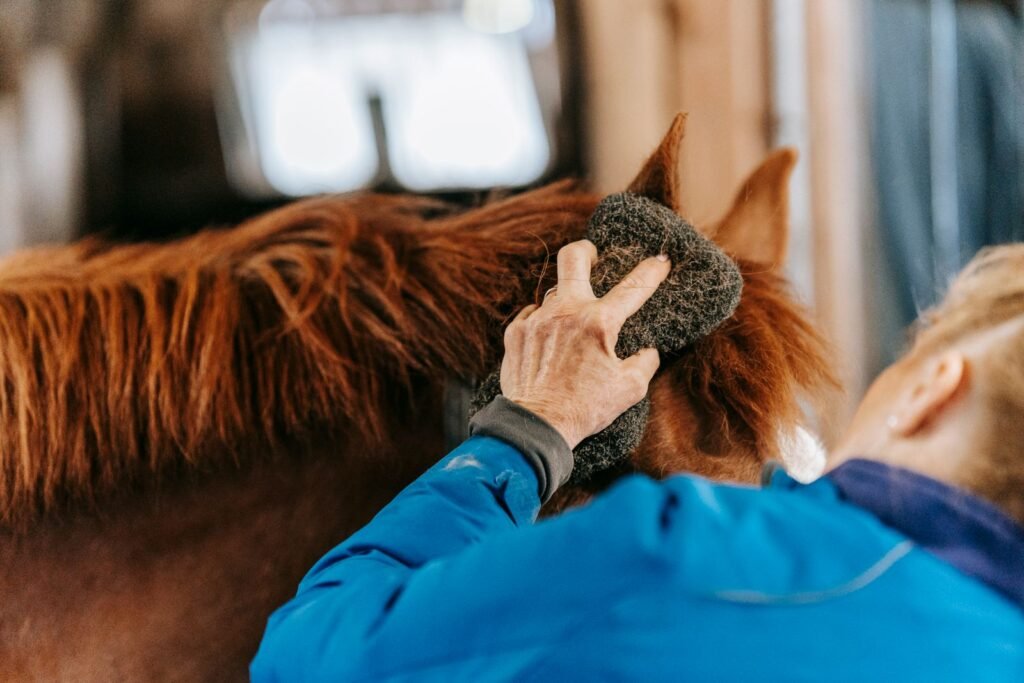
What are lice in horses and how do they spread?
Two types of louse
Horses can have a biting louse or a blood-sucking louse. Biting lice feed on skin scales and are found where the coat is finer, such as the neck and body. Sucking lice feed on blood and are found where the hair is longer, in the mane and tail.
One UK practice says the biting louse is the type most commonly encountered. Blue Cross says neither type affects people.
The life cycle
Lice complete their whole life cycle on the horse. They can only survive for a few days off it.
Eggs, called nits, are glued to the hairs and hatch in about 10 days. It takes about 3 to 4 weeks for most lice to go from nit to adult. Ordinary shampooing and washing will not dislodge the nits.
How lice spread
Lice are usually spread by direct contact between horses. Sharing rugs, saddle pads and grooming kits can also pass them on, because nits can live for a few days on equipment away from the horse.
Lice can also transfer on clothes, rugs or grooming kit. Field companions and neighbouring horses are therefore likely to have them too.
Why the colder months matter
Lice tend to be more of a problem in late winter and early spring, when thick winter coats provide a warm place to live and reproduce. Another UK practice describes autumn to late winter as the main period.
Warm rugs over a thick coat are described as an ideal breeding ground. Group housing, with more contact between horses, can spread an infestation.
Which horses are at higher risk
All horses can get lice. However, they are more common in very young, old or immune-suppressed and debilitated horses. Native breeds with thick winter coats seem particularly affected.
UK practices also link lice with conditions such as malnourishment and Cushing's disease. See Cushing's Disease (PPID) in Horses.
Signs of lice in horses
Itching is the obvious sign, and it can be intense. Some horses scratch and rub on posts and walls, bite at their skin, kick or stamp, and may even break parts of the stable.
- Restlessness, rubbing or scratching
- A dull, scruffy or listless coat, sometimes with flaky skin
- Patchy hair loss, particularly around the mane, tail, shoulders and neck
- Matting of the hair on the body, mane and tail
- Small scabs, irritated skin or raw areas
- Lice or eggs visible to the eye
- Loss of condition in more severe cases
Not every horse reacts strongly. Some show only flaky skin and a poor-quality coat, so do not rule lice out just because your horse is not rubbing.
How to check your horse for lice
Part the hair and look closely at the skin, in good light. Check around the mane, withers, tail head and forelock, although lice can be anywhere on the body, especially on a thick coat.
Adult lice look like tiny yellow-brown insects moving through the hair, a bit like walking dandruff. Nits look like small white specks stuck firmly to the hair shafts. Lice may come to the surface when the horse sweats.
Sucking lice are often found in the mane and tail. Biting lice are harder to spot and are found mostly along the back and sides.
Itching also has other causes, including sweet itch, mites, pinworm and allergies. Do not assume it is lice. See Sweet Itch in Horses and Mites in Horses.
When to Contact Your Vet
- You are not sure what is causing the itching, and want your vet to examine your horse.
- The skin is raw, infected or has been damaged by rubbing. Sucking lice can cause small wounds that become infected.
- A young, older or unwell horse has a heavy infestation, or is losing weight. Heavy sucking-louse infestations can occasionally contribute to anaemia.
- The problem does not improve after treatment, or keeps coming back.
None of the sources used describes lice as an emergency, but young, older or unwell horses can be affected more, so it is sensible to ask your vet promptly. Your vet can help you choose the best treatment option.
How vets investigate lice in horses
Diagnosis is based on seeing the lice or their eggs. Parting the hair often reveals them.
Vets also look for an underlying cause if there is one, such as poor condition or Cushing's disease, so that lice do not keep returning. One UK practice says an underlying cause needs to be identified and treated to prevent lice coming back. For weight concerns, see Why Is My Horse Losing Weight?
Treatment and care: what to expect
Your vet advises which product to use and how to use it. This is general information only.
Treating the horse
Lice are usually treated with insecticidal products applied to the coat, such as shampoos, sprays or pour-on treatments. Follow the label and your vet's advice, including any advice on protective clothing.
Products kill adult lice rather than eggs, so treatment has to be repeated. UK practices quote different intervals, from about 10 to 14 days to about three weeks. Your vet decides the timing.
Itching can take a few days to improve. You may still see lice, but they should not be moving.
Treating contacts and kit
All infested and in-contact horses should be treated, whether or not they show signs. Do not treat only the one itchy horse.
Clean and disinfect grooming kit, rugs and tack. One practice says rugs and brushes can be steamed or washed above 50°C. Sources differ on how much the environment matters. Treating the horse and its close contacts is described as the most important step, with clean kit alongside it.
Clipping and lice powders
Clipping the winter coat helps treatment reach the skin, and can remove eggs and the lice's habitat.
Sources also differ on over-the-counter lice powders. Several UK vets describe them as usually ineffective, while one says some can be effective but few are tested and licensed. Ask your vet before relying on one.
Passports and competition
In the UK, horses are food-producing animals. The passport declaration decides which medicines can be used and what records must be kept, so ask your vet about the passport before treating. If you compete, ask your vet and check your sport's rules.
Preventing the spread of lice in horses
- Do not share brushes, rugs, numnahs or other equipment between horses.
- Clean and disinfect grooming kit, and wash rugs.
- Check field companions and neighbouring horses, as they are likely to have lice too.
- If your horse has lice, avoid transferring them on your clothes, rugs or kit to other horses.
- Look out for lice through the colder months, especially in young, older or unwell horses.
How Pet Med Direct Can Help
Please speak to your vet about the right product and how often to use it. Pet Med Direct does not replace a vet examination.
You can browse our equine range. If your vet prescribes a medicine, prescription-only medicines (POM-V) are supplied solely against a valid prescription from the horse's own vet. You can read how pet prescriptions work.
Some pet medicines require a valid veterinary prescription. Pet Med Direct can only supply prescription medicines after the prescription has been checked. Always follow your vet's advice and the directions on the medicine label.
Frequently Asked Questions
Can I see lice on my horse?
Often, yes. Part the hair in good light and look at the mane, withers, tail head and forelock. Adult lice are tiny yellow-brown insects, and nits are small white specks stuck to the hair.
Why are lice in horses worse in winter?
Thick winter coats give lice a warm place to live and multiply, and warm rugs can add to this. Horses housed together also have more contact with each other.
Do I need to treat all my horses?
UK practice advice is that all infested and in-contact horses should be treated, whether or not they show signs. Ask your vet which horses to include.
Can people catch lice from horses?
No. Horse lice are species specific and do not infest people. They can come onto clothes and may cause a temporary rash, but they are unlikely to stay.
Can lice cause anaemia?
Occasionally. Sucking lice feed on blood and can contribute to anaemia in heavy infestations, particularly in young, older or unwell horses. Call your vet if you are worried about a vulnerable horse.
Will ordinary shampoo remove the nits?
No. Nits are glued to the hairs, and ordinary shampooing and washing will not dislodge them. Your vet can advise on suitable treatment and repeat timing.
Do shop-bought lice powders work?
Sources differ. Several UK vets say they are usually ineffective, while another says some may be effective but few are tested and licensed. Your vet can advise on a better-supported option.
Related Equine Health Guides
Sources and Further Reading
- Blue Cross — Skin Conditions in Horses
- Cinder Hill Equine Clinic — Ectoparasites
- Walker Equine Vets — Lice and Mites
- Riding Equine Vets — Lice - itchy horses
- Oakhill Vets — What lurks beneath - equine lice
- North West Equine Vets — Lice in Horses: Why Are We Seeing So Many at the Moment?
- MSD Veterinary Manual — Lice of Horses
- GOV.UK — Horse medicines and record keeping requirements
- GOV.UK — Retail of veterinary medicines
- British Horseracing Authority — Equine medication control in British horseracing
This article was researched from the sources listed above. It is general information for horse owners and is not a substitute for advice from your own vet.

Need pet products or prescription medicines? Visit the Pet Med Direct shop.
Shop Pet Med Direct