✓ Registered Vet Practice
🚚 Fast UK-Wide Delivery, Including Northern Ireland
℞ Prescription & Non-Prescription Products
→ Need to upload a prescription?

Is My Cat Overweight?
How to tell if you have an overweight cat, what the health risks are, and why weight loss should be planned with your vet.
Quick Answer
- The scales alone cannot answer this, because ideal weight depends on your cat's age and breed, so check body shape and condition as well.
- A cat may be overweight if you struggle to feel its ribs or spine, it has no waist when seen from above, or its belly is rounded or hangs low.
- Sources use different scoring scales and cut-offs, so ask your vet to score your cat's body condition.
- Extra weight is linked with diabetes, arthritis, urinary and breathing problems, so it is worth acting on.
- Plan weight loss with your vet, because crash diets and sudden food restriction are dangerous for cats and can cause a serious liver disease.
Many owners wonder whether they have an overweight cat, because weight tends to creep on slowly. It is also hard to see gradual changes in a cat you see every day.
PDSA says being overweight is one of the most common health problems its vets see. Most cats that are overweight are simply eating too much, and medical causes are rare. This guide shows how to check at home and how to help safely.
How to check for an overweight cat
The hands-on check
PDSA suggests running your hands along your cat's sides. The skin should move freely over the ribs, and you should feel the ribs with light touch. Then feel along the back. You should feel the spine and hip bones under the skin without being able to see them.
Also feel the base of the tail for any build-up of fat. Finally, feel under the tummy, which should go in rather than bulge out.
Blue Cross says that in an overweight cat you cannot easily see or feel the ribs. In an average cat they are easily felt under a small layer of fat.
Look from above and from the side
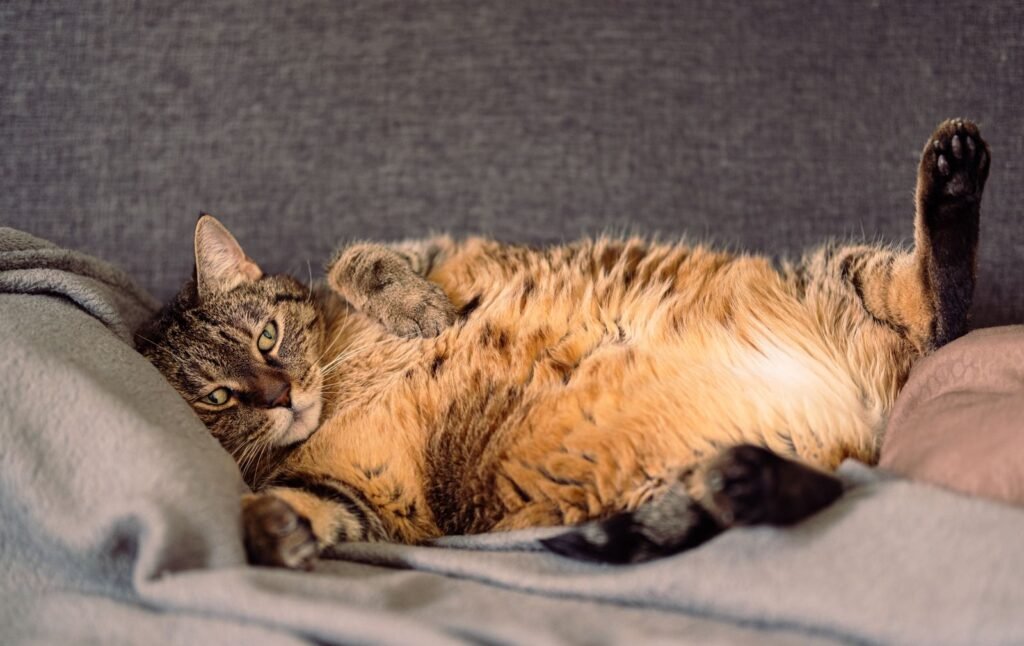
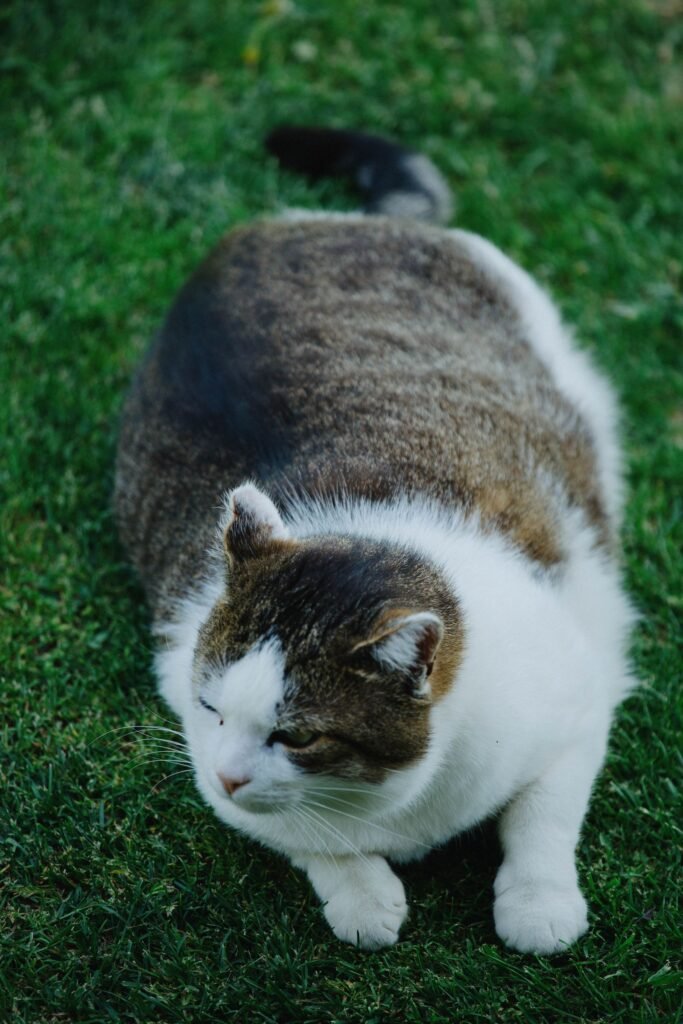
From above, your cat should have a clear waist. From the side, Blue Cross describes a slight tuck at the belly in an average cat, and a podgy belly hanging low in an overweight one. The RSPCA also says the belly should not sag underneath.
International Cat Care describes an obese cat as having a thick layer of fat over the ribs and bony areas, a pendulous "skirt" under the belly and no waist.
Body condition scores and weight
Vets use a body condition score because an ideal weight depends on age and breed. International Cat Care uses a 1 to 5 scale, while PDSA and BSAVA use a 9-point scale. Sources also draw the line between "overweight" and "obese" in different places.
For that reason, there is no single number to aim for at home. BSAVA, a UK professional body, notes that more than one score could be considered optimal for a cat. Ask your vet what is right for yours.
You can weigh your cat at the vet or at home using baby scales. PDSA suggests checking your cat's weight and shape every couple of weeks from kitten age, while Blue Cross suggests weighing every one to two months.
Why cats put on weight
Several everyday things can lead to an overweight cat. Neutered cats need less food, so they gain weight more easily if portions stay the same. Treats, human food and food from neighbours add up, and International Cat Care says tasty, energy-dense food left out all the time can lead to overeating. Scoops and cups are also easy to overfill.
International Cat Care says less active and indoor cats are at greater risk. An illness that slows a cat, such as heart disease, lung disease or arthritis, can also lead to weight gain. If an unneutered female gains weight, your vet will rule out pregnancy.
Health risks of extra weight
International Cat Care says obesity increases the risk or progression of many diseases, including diabetes, lower urinary tract disease, constipation, skin disease and fatty liver. Extra weight also puts stress on the joints. It carries a higher anaesthetic risk too.
No evidence shows that obesity causes arthritis, but it is likely to make existing arthritis worse. Read more in our guides to diabetes and arthritis in cats.
Being overweight can also worsen breathing difficulties in cats with asthma, and PDSA says cats carrying extra weight find it much harder to stay cool. Research has shown that being obese, or too thin, can shorten a cat's lifespan.
Losing weight safely
Talk to your vet before changing your cat's food. International Cat Care says sudden food restriction can make cats ill, and some health checks may be needed first. Cats Protection says not to starve your cat or use an extreme diet that cuts food drastically in one go. Blue Cross also warns against crash diets.
The reason is serious. International Cat Care says cats that lose weight too quickly can develop hepatic lipidosis, a potentially fatal liver disease where fat builds up in the liver. The MSD Veterinary Manual (US) links this liver disease with a period of poor appetite, especially in obese cats, so an overweight cat that stops eating still needs to see a vet.
Your vet can create a plan that combines feeding, exercise and careful monitoring. Loss should be gradual and steady, and for a cat that is severely overweight it may take up to a year to reach ideal condition. Many practices run weight clinics, so ask yours.
What to check at home
Do this gently when your cat is relaxed, and note what you find to share with your vet.
- Can you feel the ribs with light pressure, and is the skin loose over them?
- Can you feel the spine and hip bones without seeing them?
- Is there a visible waist when you look down from above?
- Does the tummy tuck in from the side, rather than hang low?
- Is there a build-up of fat at the base of the tail?
If you answer no to several, your cat may be carrying extra weight. Book a check with your vet.
When to Contact Your Vet
- You are worried your cat is overweight. Your vet can do a health check and, if needed, recommend a weight-loss programme.
- Your cat gains or loses weight quickly, which could be a sign that it is unwell.
- Your cat's belly looks suddenly bloated or swollen. It is not always fat, and Cats Protection says a suddenly bloated belly should be checked by a vet urgently.
- Your cat is overweight and stops eating. Poor appetite is linked with a serious liver disease in overweight cats.
- You want to change your cat's diet. Speak to your vet first.
If your cat is losing weight rather than gaining it, see our guide to why a cat may be losing weight, or our guide to a cat that is not eating.
What helps day to day
Once your vet has set a plan, these everyday habits can support it:
- Weigh food on kitchen scales rather than using scoops or cups.
- Cut down treats and human food, and reward with play, a new toy or a groom instead.
- Use puzzle feeders and wand toys to get your cat moving. For older cats, check with your vet first, as they might need pain relief.
- If you have several cats, feed the cat that needs to lose weight in a separate room and remove uneaten food.
- If neighbours feed your cat, talk to them. A "please don't feed me" collar is one option.
- Keep a food diary for a week and take it to your vet.
After your cat reaches its target, keep checking. Blue Cross says cats that have been overweight once will always be prone to weight gain.
How Pet Med Direct Can Help
Pet Med Direct is an online pet pharmacy. Our cat food range includes veterinary diets. Your vet can tell you whether a particular food suits your cat before you make any change.
If your vet prescribes medicine for a related condition, you can read how pet prescriptions work or browse our cat medication range.
Some pet medicines require a valid veterinary prescription. Pet Med Direct can only supply prescription medicines after the prescription has been checked. Always follow your vet's advice and the directions on the medicine label.
Frequently Asked Questions
How can I tell if my cat is fat or just fluffy?
Feel under the fur. You should be able to feel the ribs with light touch and the spine and hip bones, and see a waist from above. If you cannot, your cat may be overweight.
What is a healthy weight for a cat?
It varies. Cats Protection says there is no "one size fits all" weight, because it depends on size and breed. Only your vet can say what your cat should weigh.
Does neutering make cats fat?
Blue Cross says neutering does not itself make cats put on weight, but neutered cats do need fewer calories. International Cat Care also says they need less food to keep their body condition.
How fast should my overweight cat lose weight?
Slowly. A gradual, steady decrease is ideal, and it may take up to a year for a cat that is severely overweight. Your vet will plan the pace.
Can I put my cat on a diet myself?
Please speak to your vet first. Sudden food restriction can cause illness, and losing weight too fast can lead to a potentially fatal liver disease.
Is an overweight cat just a cosmetic issue?
No. Extra weight is linked with diabetes, urinary problems, arthritis, breathing problems and a shorter lifespan. PDSA says keeping a cat slim gives it the best chance of a long, happy life.
Related Cat Health Guides
Sources and Further Reading
- International Cat Care — Obesity in cats
- PDSA — Obesity in cats
- PDSA — Your cat's Body Condition Score
- PDSA — Keeping your cat's weight in check
- PDSA — How to treat your cat
- Cats Protection — Obesity in cats
- Blue Cross — Cat weight
- Blue Cross — Caring for older cats
- RSPCA — Pet obesity
- BSAVA — Obesity position statement
- International Cat Care — Arthritis in cats
- International Cat Care — Asthma and chronic bronchitis in cats
- PDSA — Heatstroke in cats
- Cats Protection — Elderly cats
- MSD Veterinary Manual (US) — Disorders of the liver and gallbladder in cats
This article was researched from the sources listed above. It is general information for cat owners and is not a substitute for advice from your own vet.

Need pet products or prescription medicines? Visit the Pet Med Direct shop.
Shop Pet Med Direct