✓ Registered Vet Practice
🚚 Fast UK-Wide Delivery, Including Northern Ireland
℞ Prescription & Non-Prescription Products
→ Need to upload a prescription?

Why Does My Dog Have Bad Breath?
The common causes of bad breath in dogs, what different smells can mean, and when to call your vet.
Quick Answer
- Bad breath is not normal in dogs, including older dogs, and it should be checked by a vet.
- Dental disease is the most common cause in dogs, but kidney disease, diabetes, something stuck in the mouth, lumps and diet can also change how a dog's breath smells.
- Dogs often keep eating despite sore teeth, so a dog that still eats is not necessarily fine.
- Contact your vet about any change in your dog's breath, especially if your dog seems in pain, has stopped eating or seems unwell.
- Daily brushing with dog toothpaste is the best way to help prevent dental problems, but never use human toothpaste.
Bad breath in dogs can be easy to dismiss, but it is not normal. PDSA says it should always be checked by a vet, even in older dogs.
The Royal Kennel Club also calls bad breath an early warning sign of disease, so it should not be put down to ageing. This guide covers the common causes, what different smells can mean, when to call your vet and how daily care can help.
What Causes Bad Breath in Dogs?
Plaque and tartar
Dental disease is the most common cause of bad breath in dogs. It starts with plaque, a sticky, colourless build-up on the teeth made from bacteria, food and saliva.
Plaque can harden into tartar, which is a hard white-to-brown coating. VCA says this can happen within days. The smell itself comes mainly from bacteria that produce smelly sulphur compounds.
Gum disease
Plaque and tartar inflame the gums, which is called gingivitis. An early sign is a thin red line along the gum edge. As it progresses, MSD says the gums change from coral-pink to red or purple, the edge swells and the gums bleed easily. Smelly breath is common at this stage.
Gingivitis can be reversed with proper cleaning. Periodontitis, however, damages the ligaments and bone that support the teeth, and that loss is permanent. MSD says it usually begins at around 4 to 6 years old.
Age and breed
Vets Now says most dogs over three have some dental disease. Small and flat-faced breeds are more prone to oral disease because their teeth sit closer together. MSD also says small breeds get periodontitis more often than large breeds.
Something stuck in the mouth, or a lump
A bone or stick stuck in the mouth can cause a bad smell, especially if it causes a wound or infection. Lumps in the mouth often become infected and smell. MSD says bad breath is one of the common signs of malignant (cancerous) mouth tumours. Only a vet can tell what a lump is.
Infection and inflammation in the mouth
PDSA lists infections and tooth root abscesses as causes. Inflammation of the mouth, tongue or throat commonly causes it too, often along with drooling.
Inflamed or infected lip folds can smell very bad and may give a foul-smelling discharge. MSD says lip fold problems occur in breeds with drooping lips, such as spaniels, English Bulldogs and Saint Bernards. Uncommon conditions, such as trenchmouth (severe gum inflammation) and fungal overgrowth, can also cause it.
Kidney disease
PDSA says kidney disease can give breath that smells of ammonia, which it compares to bleach. The reason is that toxins and waste products build up in the body. MSD also says chronic kidney failure can cause inflammation and sores in the mouth.
Diabetes
PDSA says diabetes can give sweet-smelling breath, similar to pear drops or nail polish remover.
Diet
Food can change how a dog's breath smells. PDSA gives fish-based diets as an example, because they can make the breath smell fishy. A change of diet may alter the smell too.
A smell is only a clue, so ask your vet to find the actual cause.
Signs of Dental Problems to Look For
Dogs Trust lists these signs of dental problems:
- Drooling or blood-stained saliva
- Preferring soft food to biscuits
- Red or swollen gums
- Discoloured teeth
- Facial swelling
- Pawing at the face
- Loose, broken or missing teeth
Vets Now adds losing interest in toys or chewing, eating on one side, struggling to pick up food, and blood in the water or food bowl.
Dogs often keep eating despite painful teeth. Vets Now says this should not be taken as evidence that they are fine, and the Royal Kennel Club says most dogs are very good at hiding the signs. In addition, behaviour changes in older dogs are often put down to age when dental pain may be the real cause.
How to Check Your Dog's Mouth at Home
Have your dog sit calmly, then gently lift the lips to look at the gums and visible teeth on each side.
Do not put your fingers inside your dog's mouth unless you know what you are doing, because a dog may bite by accident. If your dog pulls away or seems uncomfortable, stop. A home check also cannot show everything. Vets use dental X-rays to see the structures below the gumline.
When to Contact Your Vet
- Contact your vet about any change in your dog's breath.
- Be especially quick to call if your dog seems to be in pain, has stopped eating or seems unwell.
- Dogs Trust lists these mouth and teeth signs as reasons to contact your vet: red or sore-looking gums, discoloured teeth, tartar, a bad smell from the mouth, lumps or growths, difficulty picking up food or eating, tilting the head or eating to one side, or pawing at the mouth.
- Do not wait it out. Vets Now says dental disease can be extremely painful if left untreated and should be treated as early as possible to prevent irreversible damage.
- Dogs Trust says to seek urgent veterinary attention if your dog's tongue or gums look pale, white, bluish or dark, or if your dog has difficulty breathing or collapses.
If your dog seems to be in dental pain, call your vet. Out of hours, phone your usual vet practice, because Vets Now says your own practice will have an out-of-hours service even when it is closed.
How Vets Investigate and Treat the Cause
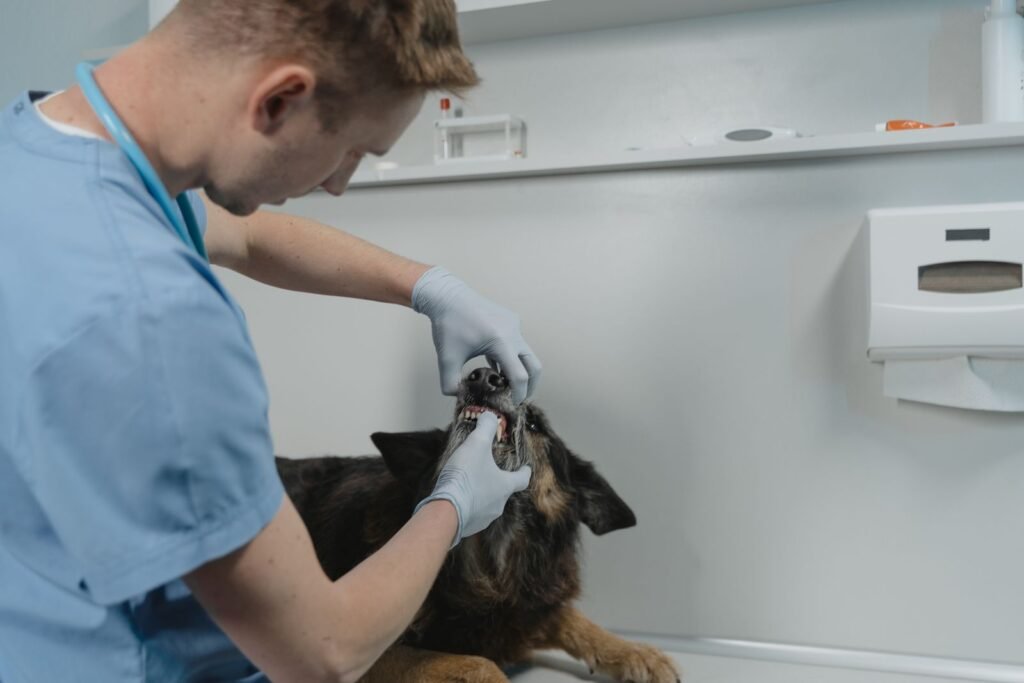
Vets start with a thorough exam of the whole mouth. They also use dental X-rays to see below the gumline. If gingivitis does not respond to treatment, MSD says other conditions, such as immune problems and diabetes, should be checked.
For one form of mouth inflammation called stomatitis, MSD says blood tests and tissue samples can rule out other causes, such as advanced kidney disease.
Treatment for dental disease is usually a professional clean and polish under general anaesthetic. This removes plaque and tartar above and below the gumline. The Royal Kennel Club explains why anaesthesia is recommended: disease is often not discovered until the dog is examined asleep.
Teeth with advanced gum disease often need extracting, and MSD says dogs manage surprisingly well without them. Vets may also use antibiotics as part of treatment.
How to Help Prevent Bad Breath in Dogs
Daily brushing
After a professional clean, VCA says daily plaque control is essential to stop the problem coming back. Daily brushing is the best prevention. MSD puts it this way: gum disease will not develop around clean teeth.
Use dog toothpaste only. Dogs Trust warns that human toothpaste can be toxic for dogs. It also says enzymatic dog toothpaste helps break down plaque and reduces the smell.
Introduce brushing gradually, with rewards, and ideally from puppyhood. If your dog pulls away or seems uncomfortable, stop and take a break. If your dog will not allow brushing, MSD says wiping the outside of the teeth with gauze at least every 2 to 3 days can help.
If you suspect gum disease, or your dog has never had its teeth brushed, speak to your vet first. Vets Now says brushing may be painful or ineffective in that case.
Chews, diets and products
Dogs Trust says brushing is the best way to keep your dog's mouth healthy, and that water additives, certain foods, treats or toys can be used alongside it. Always check with your vet before using any of them.
VCA and MSD both point to the Veterinary Oral Health Council (VOHC). VCA says the VOHC only accepts dental products proven to reduce plaque and tartar, including dental diets, treats and water additives.
Be careful with hard objects, because they can fracture teeth. MSD lists real bones, hooves, antlers and hard nylon toys as examples to avoid. Vets Now advises avoiding bones and sticks. Because advice on chews varies, ask your vet which are suitable for your dog.
Regular dental checks
VCA and the Royal Kennel Club both recommend dental exams at least twice a year. This matters because Vets Now says bacteria from periodontal disease can enter the bloodstream, and affected pets are more likely to develop heart, kidney and liver disease.
How Pet Med Direct Can Help
Pet Med Direct is a UK online pet pharmacy. If your vet has advised dental care at home, you can browse our non-prescription dog dental care range and ask your vet which options, if any, suit your dog.
If your vet prescribes a medicine, our guide explains how pet prescriptions work. You can also read our Dental Care Matters guide.
Some pet medicines require a valid veterinary prescription. Pet Med Direct can only supply prescription medicines after the prescription has been checked. Always follow your vet's advice and the directions on the medicine label.
Frequently Asked Questions
Is bad breath normal in dogs?
No. PDSA says it should always be checked by a vet, even in older dogs.
Why does my dog's breath smell like fish, ammonia or something sweet?
PDSA says fish-based diets can make breath smell fishy, kidney disease can give an ammonia smell, and diabetes can give a sweet smell like pear drops. These are only clues, so contact your vet about any change.
Can I use human toothpaste on my dog?
No. Use dog toothpaste only, because human toothpaste can be toxic for dogs.
Do dental chews and dental diets work?
Dogs Trust says these can be used alongside brushing, which it calls the best way to keep your dog's mouth healthy. Check with your vet first.
Will my dog need an anaesthetic for a dental?
Treatment is usually a professional clean and polish under general anaesthetic. The Royal Kennel Club says this is because disease is often not discovered until the dog is examined asleep.
Is bad breath an emergency?
Contact your vet about any change in your dog's breath. PDSA says to do so especially if your dog seems in pain, has stopped eating or seems unwell. Dogs Trust says pale, white, bluish or dark gums or tongue need urgent veterinary attention.
Related Dog Health Guides
Sources and Further Reading
- PDSA — Bad breath in dogs
- VCA Animal Hospitals — Halitosis in Dogs
- MSD Veterinary Manual — Dental Disorders of Dogs
- MSD Veterinary Manual — Disorders of the Mouth in Dogs
- Dogs Trust — Dog dental hygiene and how to clean your dog's teeth
- Vets Now — Dental disease in dogs, what to do about bad teeth and gingivitis
- Vets Now — Teeth problems in dogs: how to check for dog dental problems at home
- Royal Kennel Club — Dental care
- Dogs Trust — When to take your dog to the vet
This article was researched from the sources listed above. It is general information for dog owners and is not a substitute for advice from your own vet.

Need pet products or prescription medicines? Visit the Pet Med Direct shop.
Shop Pet Med Direct