✓ Registered Vet Practice
🚚 Fast UK-Wide Delivery, Including Northern Ireland
℞ Prescription & Non-Prescription Products
→ Need to upload a prescription?

How Can I Tell If My Cat Is in Pain?
Cats hide pain well, so the first sign that a cat is in pain is often a small change in behaviour.
Quick Answer
- Cats are very good at hiding pain, so the most useful clue that a cat is in pain is a change from its normal behaviour rather than an obvious limp.
- Look for changes in how your cat moves, rests, grooms, eats, uses the litter tray and behaves around people.
- Facial signs can include narrowed eyes, ears held back, a tense muzzle and whiskers sticking straight out.
- Never give your cat human painkillers, because medicines such as paracetamol and ibuprofen are highly toxic to cats.
- If you suspect pain, contact your vet straight away, and treat severe pain as a possible emergency.
How can you tell if your cat is in pain? Cats are very good at hiding discomfort, so the signs are often subtle and easy to miss.
Cats are more likely to show slight changes in lifestyle or behaviour than a limp. Chronic pain is also often mistakenly put down to old age. Knowing how your cat normally behaves is the most useful yardstick you have.

Changes that suggest a cat is in pain
Every cat shows pain differently. Age, environment and general health all play a part. Changes in behaviour are usually the earliest signs of pain, and International Cat Care says they tend to be the most significant sign at home.
Mood and behaviour
A normally friendly cat may not want to be stroked or groomed. It may move away, vocalise or lash out. Hissing, growling, scratching or biting can all be signs of pain.
Other changes include hiding more than usual, being less tolerant of people, and losing interest in play or going outside. Some cats are restless, pace or circle, or sleep badly. Others seem listless and low in energy.
Cats Protection also lists vocalising, especially when moving or using the litter tray. Some cats purr when they are in pain, so purring does not mean a cat is comfortable.
Movement and posture
A cat in pain may move more slowly or stiffly, especially on stairs. It may limp, or hesitate before jumping up or down. It may also be stiff after resting, or use a particular leg when going up and down stairs. Some cats stop jumping onto beds because they expect it to hurt.
Resting position can help too. A relaxed cat often curls up. A painful cat tends to rest hunched up and finds it hard to settle. Stiffness is harder to spot than a limp. For long-term joint pain, see How Do I Know If My Cat Has Arthritis? and Why Is My Cat Limping?
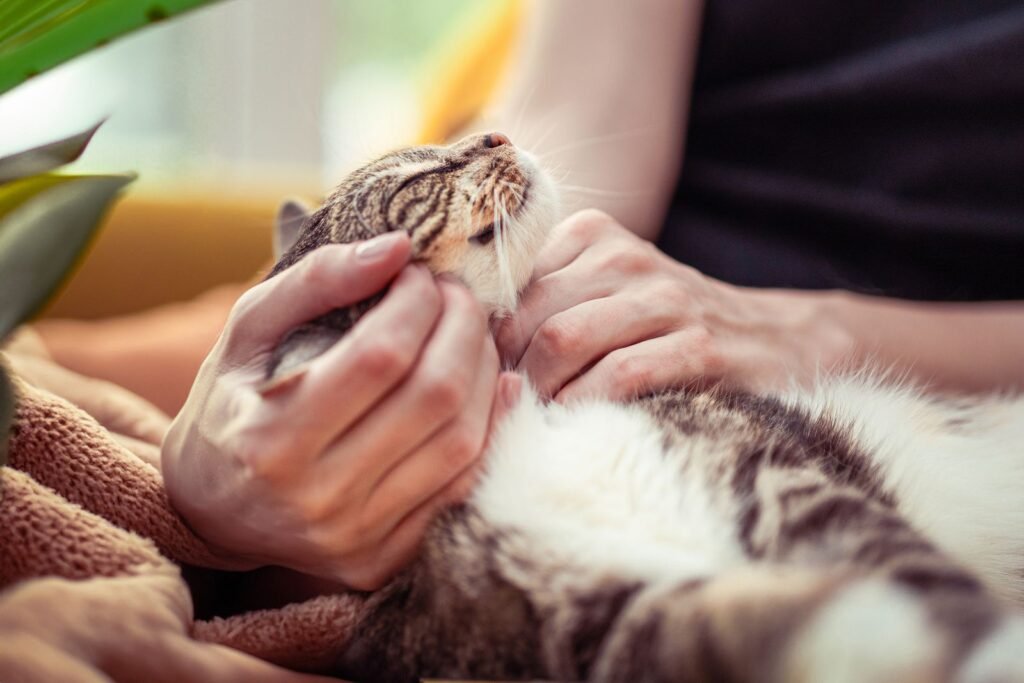
The face
International Cat Care describes narrowed eyes, ears held further back, a tense muzzle and whiskers sticking straight out from the sides of the face instead of loose and curved.
Battersea says a cat may squint or close its eyes. The ears may look slightly flattened or pressed to the sides, and the mouth, nose and cheeks may look tense. Some cats show only some of these signs. Vets Now also lists avoiding bright areas.
Treat facial signs as one clue among several, not as a test. If you are worried, call your vet.
Grooming, toileting, eating and sleep
Grooming may drop, leaving a scruffy or matted coat. Some cats instead overgroom one area, which can cause bald patches or sore skin. Toileting outside the litter tray, spraying, or passing faeces less often or with difficulty can also be signs.
A cat in pain may eat less or become fussier. It may sleep more, or choose unusual places such as under beds or in wardrobes. Pain in the mouth can bring drooling, pawing at the face, chewing on one side and bad breath. See What Are the Signs of Dental Disease in Cats? for more.
Short-term and long-term pain
Acute pain comes on suddenly and is expected to last hours to days. Causes include surgery, pancreatitis, infections, abscesses, broken bones and cat-fight bites. Our guide to what to do if your cat has an abscess covers one common cause.
Chronic pain lasts longer, such as pain from dental disease or osteoarthritis. Intense short-term pain is more likely to give obvious clues. Chronic pain can show very little until it is intense, and it can also affect a cat emotionally over the long term.
Never give your cat human painkillers
Do not try to treat a cat in pain at home with human painkillers. Paracetamol and ibuprofen are highly toxic to cats and can cause severe illness and even death. Cats Protection says as little as one tablet could be fatal.
Do not use animal painkillers left over from another pet or condition unless a vet tells you to. Natural or herbal remedies also have little to no scientific evidence behind them. Use them only if your vet directs it.
Our full guide, Can I Give My Cat Human Painkillers?, explains the risks. If your cat may have swallowed a tablet, go to the vet straight away.
What to do if you think your cat is in pain
Contact your vet straight away. The vet will try to find the cause and suitable treatment. Meanwhile, these steps can help:
- Note what has changed from your cat's normal behaviour.
- Film your cat going up stairs or jumping down. Cats may not show many signs in the clinic.
- Keep an injured cat still and comfortable, and handle it gently. Use a thick blanket if necessary, but a blanket will not protect the cat from further injury.
- Transport your cat in a secure, padded carrier.
- Stay calm and use a soothing voice. Even a friendly cat can scratch or bite when in pain.
Blue Cross also suggests low bedding, food and water close by, a shallow litter tray, rugs on slippery floors and places to hide. Avoid touching painful areas. For a cat recovering from illness or surgery, soft bedding in a quiet, comfortable, confined space helps.
Emergency: Contact a Vet Immediately If…
- Your cat shows signs of severe pain, such as crying, rapid breathing, lying very still or rigid, protecting part of its body, growling or hissing when touched, or wide pupils.
- Your cat has a sudden limp, or cannot put weight on a leg.
- Your cat is straining to pass urine, or cannot pass urine.
- Your cat has sudden severe pain (crying, yowling, breathing quickly or with its mouth open), or drags one or both back legs or cannot stand. This may be saddle thrombus (a blood clot), a life-threatening emergency.
- Your cat has difficulty breathing, is weak, has collapsed, has a painful or closed eye, or has a suddenly bloated belly.
- Your cat has been injured, or may have swallowed poison or a human painkiller.
Call your vet, or the nearest out-of-hours emergency vet if yours is closed, straight away, and phone ahead on the way.
When to Contact Your Vet
- Whenever you suspect pain. Contact your vet straight away.
- If there is a lasting change in behaviour, such as hiding, grooming changes or litter-tray changes.
- If your cat seems stiff, is slowing down or is reluctant to jump. Do not assume it is just old age.
- If a mild limp has not improved within 24 hours.
- If your cat is already on pain relief and the pain seems worse, or the medicine seems to stop working.
- If your cat is on pain relief and is not eating, or shows other signs of illness such as sickness, diarrhoea or excessive drinking. Contact your vet before giving the next dose.
Attempts to handle a very sick or injured cat can add stress and worsen pain or breathing difficulty, so follow your vet's advice.
How vets assess and treat pain
Vets use pain assessment tools that look at facial expression, posture and resting position. They also check how a cat reacts when a sore area is gently touched, and repeat the assessment to see whether the cat is more comfortable.
Depending on the cause, your vet might prescribe pain relief or anti-inflammatory medication, or recommend tests. Managing pain is about more than medicine. Nursing care and the home environment also play a fundamental role.
Both short-term and long-term pain can be eased with careful management. Pain can also change over time, so keep your vet updated.
How Pet Med Direct Can Help
Your vet decides what pain relief your cat needs. If they prescribe a medicine, our guides to how pet prescriptions work and repeat pet prescriptions explain how we can help.
We also list a prescription-only pain relief category. These are prescription-only medicines, supplied solely against a valid prescription from a cat's own vet. A listing does not mean your cat needs them.
Some pet medicines require a valid veterinary prescription. Pet Med Direct can only supply prescription medicines after the prescription has been checked. Always follow your vet's advice and the directions on the medicine label.
Frequently Asked Questions
Can a cat purr when it is in pain?
Yes. Some cats purr when they are in pain, so purring alone does not tell you a cat is comfortable.
Is a limp the main sign of pain in cats?
No. Cats are much more likely to show slight changes in behaviour or lifestyle than a limp. A change from normal is the most useful clue.
Why do cats hide pain?
Vets Now suggests that wild cats that looked vulnerable would be at risk, and that domestic cats likely kept the trait. Whatever the reason, it means signs are subtle.
Can I tell my cat is in pain from its face?
Facial signs can be a clue. Narrowed eyes, ears held back, a tense muzzle and whiskers sticking out are examples. However, they are not a test, so call your vet if you are worried.
Is stiffness after resting a sign of pain?
It can be. Being stiff after resting, or using a particular leg when going up and down stairs, is listed as a sign of pain. Your vet can check for causes such as arthritis.
Can I give my cat paracetamol or ibuprofen?
No. Both are highly toxic to cats. Speak to your vet, who can advise on safe pain relief.
How long should I wait before calling the vet?
Do not wait. Contact your vet straight away if you suspect pain. Severe pain, a sudden limp, or a leg your cat cannot put weight on needs an emergency appointment.
Related Cat Health Guides
Sources and Further Reading
- International Cat Care — Acute pain: Recognising and managing acute pain in cats (Cat Carer Guide)
- International Cat Care — Treating chronic pain with NSAIDs: a guide for caregivers
- Blue Cross — How to Spot if Your Cat is in Pain
- Battersea — How do I tell if my cat is in pain?
- Vets Now — How to tell if a cat is in pain
- Cats Protection — Signs of pain
- PDSA — Severe pain in pets
- PDSA — Limping and stiffness in cats
- PDSA — Mouth pain in cats
- PDSA — Saddle thrombus (aortic thromboembolism) in cats
- Blue Cross — Emergencies in Cats
- International Cat Care — Feline idiopathic cystitis (FIC) in cats
- Cats Protection — Cat Poisoning Symptoms and How to Spot It
- International Cat Care — Arthritis in cats
This article was researched from the sources listed above. It is general information for cat owners and is not a substitute for advice from your own vet.

Need pet products or prescription medicines? Visit the Pet Med Direct shop.
Shop Pet Med Direct