✓ Registered Vet Practice
🚚 Fast UK-Wide Delivery, Including Northern Ireland
℞ Prescription & Non-Prescription Products
→ Need to upload a prescription?

What Are the Signs of Dental Disease in Cats?
Dental disease in cats is common, and cats hide the pain well. Here are the signs to look for, how vets treat it and how to care for your cat's teeth.
Quick Answer
- Dental disease is common in cats, especially as they get older, but most cats try to hide pain, so signs often only appear once it is severe.
- Signs include bad breath, red, sore or bleeding gums, tartar, drooling, pawing at the mouth, difficulty eating, weight loss, loose teeth and reduced grooming.
- Plaque hardens into tartar that brushing cannot remove, and while early gum inflammation can often be reversed, very advanced gum disease may leave extraction as the only option.
- Vets diagnose dental disease with a mouth examination, sometimes under sedation or anaesthesia, plus dental X-rays, and treatment can include a scale and polish or tooth removal.
- A broken tooth, a cat that cannot close their mouth, or a cat that has stopped eating needs an urgent vet appointment.
Dental disease in cats is often linked to a build-up of plaque and tartar, which can lead to gum disease. Other dental problems, such as broken teeth, can also cause pain.
This guide covers the main dental conditions, the signs you can spot, what vets do, and how to look after your cat's teeth at home. If your main worry is a smell, start with our guide to why a cat has bad breath, which covers causes outside the mouth too.
The Main Types of Dental Disease in Cats
Plaque and tartar
Plaque is a soft mix of saliva, food and bacteria that builds up through the day. If it is not removed regularly, it hardens into tartar.
Tartar looks like a cream, yellow or brown hard deposit. You cannot brush it off, and a vet scale and polish under anaesthetic is usually needed to remove it.
Gingivitis
Gingivitis is inflammation of the gums, which causes pain, redness and bleeding. It is the early stage of periodontal disease, and it is most commonly caused by tartar build-up, but cat flu, FIV and FeLV can also lead to it.
It is extremely common in cats of all ages. Mild cases can usually be reversed with home care such as toothbrushing, whereas severe gingivitis is likely to need a vet scale and polish under general anaesthetic. Left untreated, it can lead to receding gums, tooth loss and other health problems.
Kittens often get a temporary gum inflammation around five months old as adult teeth come through. It usually settles in four to six weeks, and your vet can check anything that looks abnormal.
Periodontitis
Periodontitis is a very advanced gum disease, and it is more common in older cats. The gums are inflamed and receding, there is lots of tartar, and the supporting tissue is diseased so teeth become unstable.
Pus may be seen. At this stage the tooth is so diseased that extraction is the only treatment option.

Tooth resorption
Feline resorptive lesions are holes that develop in the teeth along the gum line. They weaken the tooth so it can snap off at the gum line, leaving a very painful root.
They are very common and can be hard to spot, sometimes looking like a small amount of gum growing out of the tooth. Vets find them with dental X-rays or by probing the teeth under general anaesthetic.
Signs can include head shaking, drooling and discomfort when chewing. Touching the lesion often makes the cat chatter their teeth. The defects cannot be filled, so affected teeth need extracting and the others should be monitored.
Stomatitis (whole-mouth inflammation)
Gingivostomatitis is a severe form of gum inflammation that affects the whole mouth. It is thought to be triggered when the immune system overreacts to plaque, tartar, cat flu, FIV or FeLV.
It is extremely painful. Cats often have difficulty eating, drool and paw at their mouth. In very severe cases, removing all of the cheek teeth may be the only option.
Broken teeth, abscesses and retained baby teeth
Broken teeth are very painful because each tooth has a nerve inside. Once a tooth is damaged, infection and a tooth root abscess are more likely, so removal is often needed. A tooth root abscess usually causes swelling on one side of the face, just under the eye.
Baby teeth that stay in place cause crowding that traps food and bacteria. Your vet might recommend removing any that remain after six months old.
Signs of Dental Disease in Cats to Look For
The signs of dental disease in cats can be subtle, so look for changes in eating, grooming and behaviour as well as the mouth itself.
- Bad breath, or red, sore or bleeding gums.
- Tartar on the teeth, loose or wobbly teeth, or swelling around the face, jaw or cheeks.
- Reduced appetite, weight loss, or difficulty eating, such as chewing on one side or preferring soft food.
- Drooling, or pawing at the mouth or face.
- Hissing at or shying away from food, or not wanting the face touched.
- Grooming less, which can leave a matted or poor coat.
- Becoming more irritable, isolated or hiding.
Most cats try to hide pain, so it is not uncommon for a cat to show no signs yet have severe dental disease. Many cats also keep eating through the pain, although their appetite may be reduced.
Some cats are more at risk. These include older cats, cats with infectious disease such as cat flu, FIV or FeLV, and cats with misaligned teeth, such as short-nosed breeds like Persians.
Emergency: Contact a Vet Immediately If…
- Your cat has broken a tooth.
- Your cat cannot close their mouth.
- Your cat has stopped eating.
PDSA advises an urgent appointment for these, so call your vet straight away, or the nearest out-of-hours emergency vet if yours is closed.
When to Contact Your Vet
- You notice any problem with your cat's mouth. Contact your vet as soon as you notice it.
- You see swelling on one side of the face, especially under the eye, which can be a sign of a tooth root abscess.
- Your cat is drooling, pawing at the mouth, has bleeding gums, or is eating less or losing weight. Cats Protection says these all warrant a specific trip to the vet.
- It has been a year or more since your cat's teeth were last checked.
Dental checks at least once a year are a good habit, and more often if your cat has had dental problems. Your cat's yearly booster visit is a good time to ask.
How Vets Diagnose and Treat Dental Disease in Cats
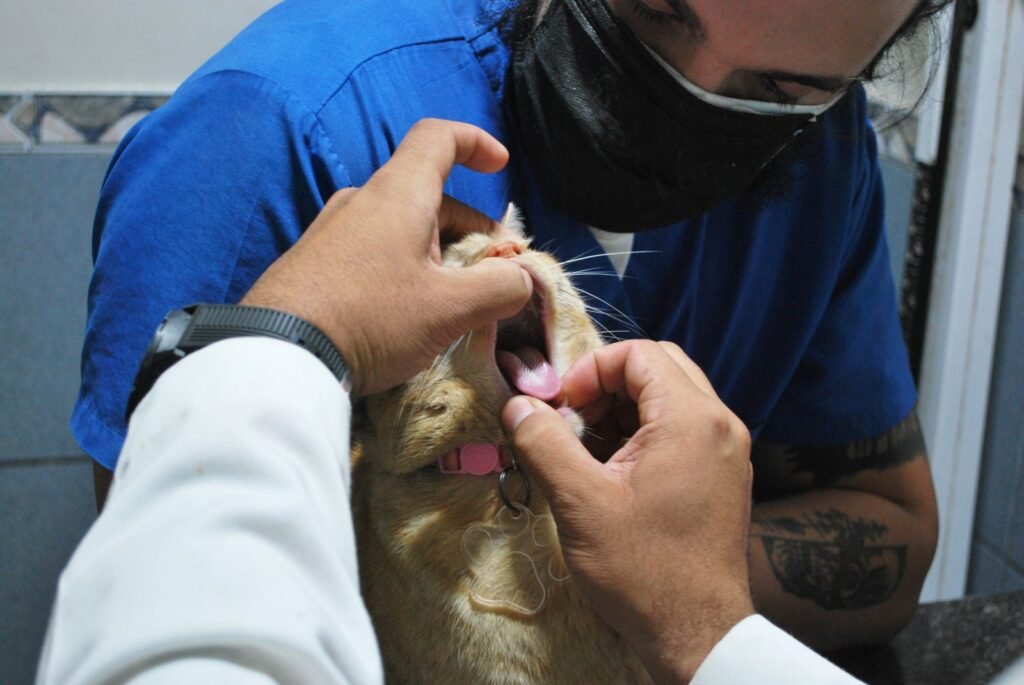
Your vet will examine the mouth thoroughly, which may need sedation or anaesthesia. They will probe the teeth, take dental X-rays and sometimes run blood tests. They look for gum inflammation, ulcers, tooth erosion, plaque and tartar, and signs of underlying disease.
Treatment can include pain relief, antibiotics if there is infection, a scale and polish under general anaesthetic, and tooth removal if disease is severe. Removal stops pain and helps prevent infection of the jaw bone. Cats adapt very well to having teeth removed, even all of them.
After a scale and polish or extractions, allow time for the mouth to heal before starting any home brushing. The earlier dental disease is found, the better, and early-stage disease may be reversible.
Home Tooth Care for Your Cat
Brushing is by far the best way to keep a cat's mouth healthy, because it removes plaque before it turns into tartar. It is easier to start in kittenhood, but older cats can learn. Use a toothpaste and brush made for cats, and be wary of finger brushes because of the bite risk.
Start only if the teeth look evenly off-white with no odour and the gums are light pink. If there are signs of dental disease, brushing could hurt, so speak to your vet first. Stop if your cat seems in pain, or if the gums look sore or bleed.
Build up slowly, starting with just a few seconds. Brushing should never become a battle. Once a day is ideal if your cat is happy with it.
Once a month, check the mouth. Gums should be salmon pink, with no redness, ulcers, bleeding or lumps, and teeth should look white and smooth. Ideally, ask a second person to hold your cat gently, and stop if they become stressed.
What Not to Do
Never use human toothpaste or mouthwash on cats. Human toothpaste contains high levels of fluoride, is too frothy and can cause stomach irritation.
If your cat will not tolerate brushing, ask your vet about alternatives such as dental chews, dental diets or gels. Gels are not as effective as brushing, and you should not rely on treats alone. Sources differ on how much diet affects teeth, so check with your vet before changing your cat's diet.
How Pet Med Direct Can Help
Pet Med Direct stocks a range of non-prescription cat dental care products. They do not replace brushing or vet dental treatment, so ask your vet what suits your cat.
You can also browse our cat food range, which includes veterinary diets. If your vet prescribes medicine after a dental procedure, see how pet prescriptions work.
Some pet medicines require a valid veterinary prescription. Pet Med Direct can only supply prescription medicines after the prescription has been checked. Always follow your vet's advice and the directions on the medicine label.
Frequently Asked Questions
Can dental disease in cats be reversed?
Early gingivitis is often reversible with proper dental care. Severe gingivitis is likely to need a vet scale and polish, and advanced periodontitis may leave extraction as the only option, so earlier is better.
My cat is still eating. Could they have dental disease?
Yes. Many cats keep eating through the pain, though their appetite may be reduced. Cats can also have severe dental disease with no obvious signs at all.
How often should a vet check my cat's teeth?
At least once a year is a sensible minimum, and more often if your cat has had dental problems. PDSA also suggests a quick home check every month.
Can dental disease affect my cat's wider health?
Left untreated, dental problems can sometimes lead to other issues such as kidney and heart disease. This is one more reason not to wait.
Is bad breath always a sign of dental disease?
No. It is a common sign, but other illnesses can cause it, and a cat can have dental disease without a change in breath. Our guide on cat bad breath explains the other causes.
Related Cat Health Guides
Sources and Further Reading
- PDSA — Dental Disease in Cats
- PDSA — Vet Q&A: Am I doing enough for my cat's dental care?
- PDSA — Mouth pain in cats
- International Cat Care — Dental Disease in Cats
- International Cat Care — How to brush your cat's teeth
- Blue Cross — Cat dental care
- Cats Protection — Gingivitis in Cats
- Cats Protection — Teeth and oral health (Veterinary Guide 14)
- Cats Protection — Why does my cat have bad breath?
This article was researched from the sources listed above. It is general information for cat owners and is not a substitute for advice from your own vet.

Need pet products or prescription medicines? Visit the Pet Med Direct shop.
Shop Pet Med Direct